
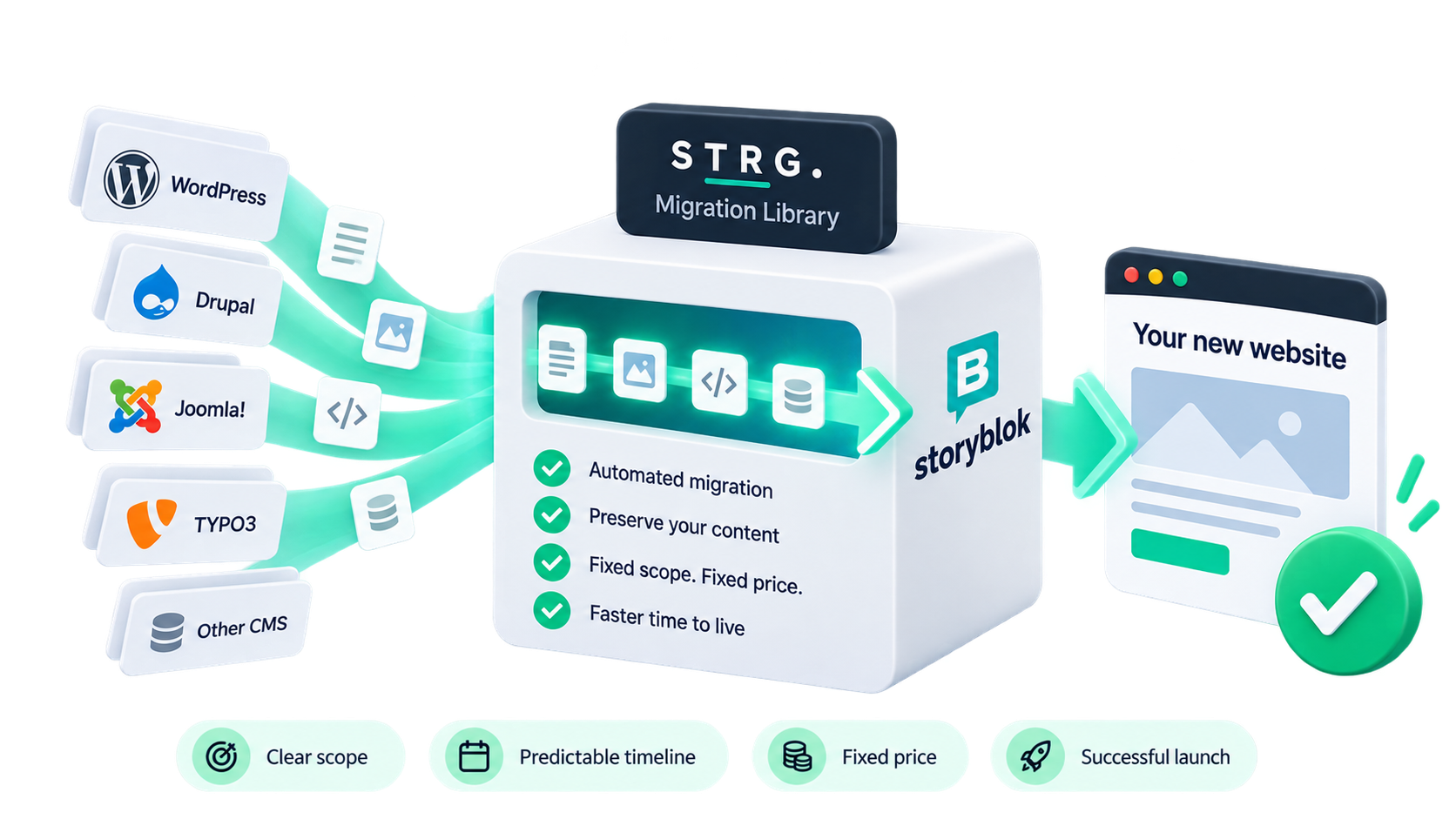
Why the move gets postponed
Not because of the design. Because of 15 years of legacy estate: tens of thousands of articles, hundreds of thousands of assets, grown taxonomies, paywall assignments and historical URLs in thousands of backlinks. Plus a frontend made up of template variants that no one fully understands anymore.
Migrated manually, it costs twice what the provider estimates.
The cost reality at STRG.AT
First, we are big fans of open-source projects. We have released many of our own models and have always been active in this community. Even so, the underlying business model is not without risk for clients. The licenses are free, but Time & Material can very quickly become a money pit.
We have therefore changed our own way of working significantly in recent years and developed a different pricing model. The risk on our side has increased, but for our clients it is a clear advantage.
Billing is exactly as agreed at the outset. Both during implementation and in later support. The principle is „Fair Use“ and for both sides this is by far the better model than the tiresome „Time & Material“ that is common especially in open-source projects.
This finally ends the era of exploding costs. Online projects have become predictable, and project bureaucracy has been reduced to a minimum.
What makes Storyblok future-proof
One content source, all channels. Web, app, newsletter, partner feeds and AI systems access the same source via API.
Structured content instead of HTML blobs. Component-based and machine-readable, so it remains usable for the search systems and AI agents of the coming years.
No frontend lock-in. New design in three years without a new migration.
Edge performance. Milliseconds instead of seconds, measurable in Core Web Vitals.
Visual Editor. The only headless CMS where editors see what they are building. Otherwise, headless fails precisely here.
No dedicated CMS server. No patch nights, no plugin chain.
Part 1: The content
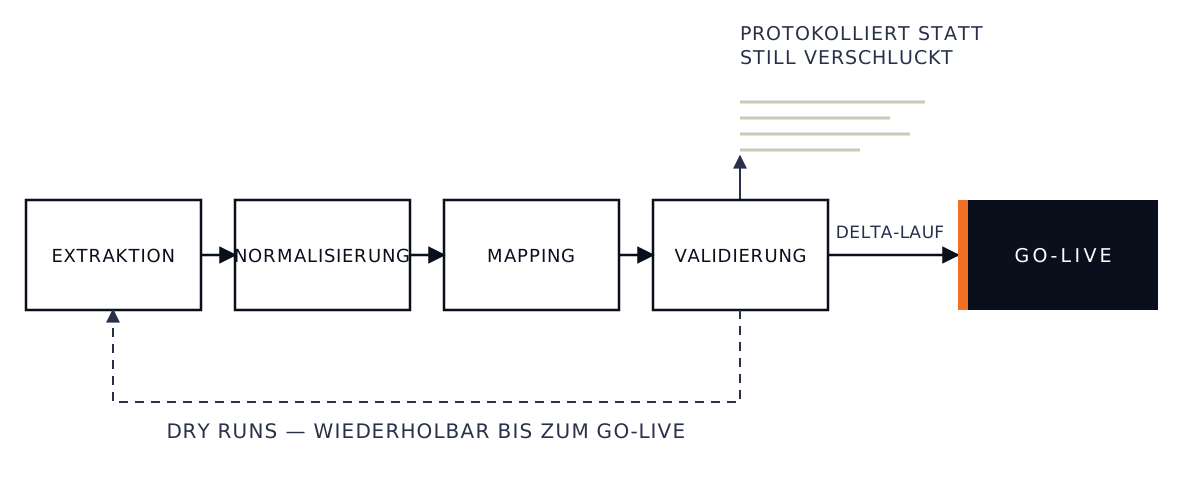
Our migration library consists of source adapters, a mapping layer and validation.
Extraction from database, API or export, depending on the source system.
Normalization. Grown editorial HTML is parsed and translated into real Storyblok components, including embeds, galleries and info boxes.
Mapping of content types, fields, taxonomies, authors and assets to the new schema.
Validation. Automated diffs across data records, field population, image references and internal links. Anything that cannot be mapped cleanly is logged instead of silently swallowed.
Dry runs. Repeatable until go-live, followed by one final delta run.
Included: 301 redirect maps, SEO metadata and canonical structures, integration with paywall, consent management and editorial systems, edge caching and invalidation.
Part 2: The interface
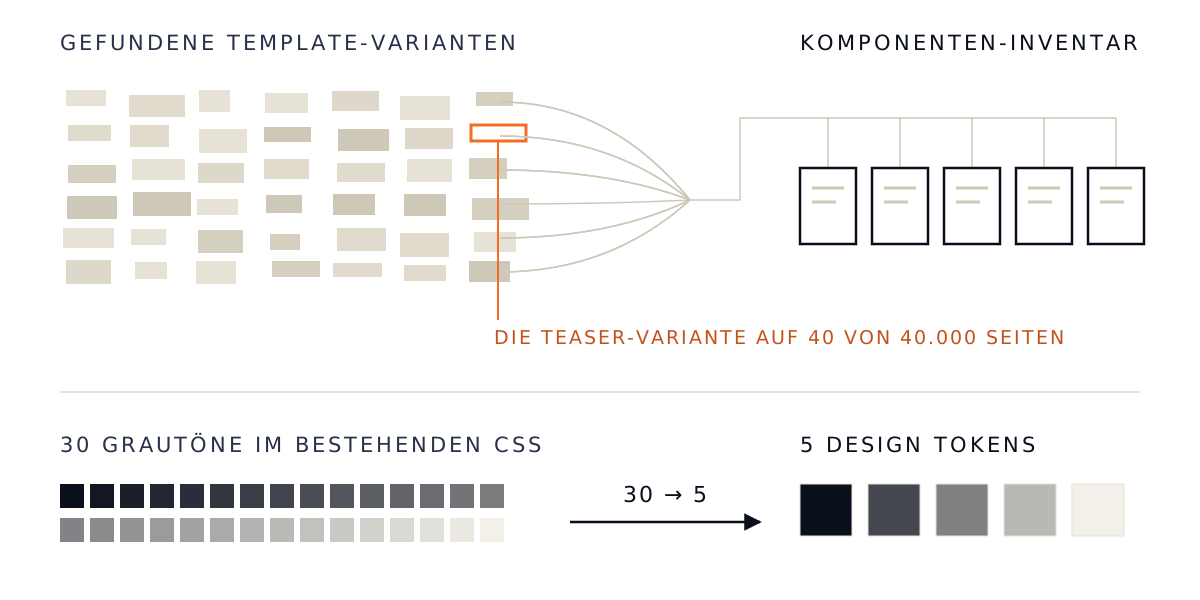
The content is one half. The other half is the templates. Manual work reliably misses the teaser variant that appears on only 40 of 40.000 pages. So we automate that too:
Component inventory from crawl and template analysis. A reliable list instead of an estimate, including what will be removed without replacement.
Design Tokens extracted and condensed from the existing CSS. 30 shades of gray become five.
One schema, two sides. Storyblok block schema and typed frontend are generated from a shared definition and cannot drift apart.
Visual regression tests old against new, across thousands of pages and all viewports. Deviations appear as a screenshot diff in the build.
Build gates for accessibility, performance budget and links. Anything that violates them does not get through.
This requires knowledge of both sides: how TYPO3, WordPress and AEM generate their output, and how a modern frontend is built today. Exactly this knowledge is built into our tools.
Where your budget belongs
A CMS change almost never comes alone. It is usually tied to a content and visual relaunch: new structure, new imagery, revised sections, sharper target groups, cleaned-up navigation. Both compete for the same budget, and migration usually wins because it has to be finished first.
That is the wrong order. Migration is disciplined work: complete, repeatable, verifiable, and therefore automatable. What your website should be in five years is not. Content strategy, information architecture, design and brand presence require people, discussion and iterations.
That is why we cap not only the migration, but the entire project. Because the technical side is fixed, the available energy goes into the content questions instead of discussions about effort estimates.
Fixed price for the entire project
We do not sell hours. We analyze the source system, define the target schema and scope, and quote a price for the complete project: migration, frontend, editorial onboarding, go-live. If it becomes more complex than expected, that is our problem, not yours.
We can offer this because our tools reduce the unknowns. We do not estimate how long a move might take. We know where each source system tends to get stuck.
For you, this means: one budget, one date, no change orders.
STRG.AT is a Storyblok Premium Partner
Content modeling, frontend, editorial onboarding, operations. We know both sides of the move because, with STRG.CMS, we built and operated a CMS ourselves for years.
Tell us your source system and the approximate content volume. You will receive a firm price for the entire project.