
- CLIENT
- Die Furche
- SECTOR
- Media
- SCOPE
- CMS · Semantics · NLP
- SINCE
- 2018
Lifting the treasure of an archive — the Furche Navigator as a digital time machine.
strg.at:~$init --driven-by-humans --supported-by-ai
www.furche.at is built on a new publishing concept and the idea of lifting the treasure of the Furche — its richly textured archive going back to 1945. Together we developed a new concept for digital reading and condensed the semantic embedding of more than 150,000 historical articles into a navigation experience.
- 150k+
- Archive articles digitised
- 1945
- Founded — and online today
- BERT
- semantic embedding
- Navigator
- Time-machine under every article
About the publication
A weekly with a mission
Die Furche was founded as a weekly newspaper in 1945. Its mission was to confront the antisemitism in Austria's Christian community with high-quality content. In its earliest years it was a project of the Catholic Church, built and co-financed with the United States Army. Pursuing that mission meant that editorial quality was prioritised from the very beginning.
 01
01The challenge
An archive since 1945 with more than 150,000 articles — gathering dust in print, hard to find, its value undigitised.
 02
02The approach
The entire archive made readable via OCR, semantically embedded with BERT and condensed into a Navigator timeline via STRG.behave.
 03
03The outcome
The Furche Navigator — a time machine under every article. The archive becomes a recommendation system rather than a search system; the medium's history comes alive.
The underlying idea
Digital transformation means discovering the new.
The task was to develop a new concept for digital reading at Die Furche. In the conception work we looked for ways to achieve a real digital transformation of the medium. For us, digital transformation means something other than just doing things on a computer — it means discovering possibilities that only digital ways of working make possible.
It was clear that one of the Furche's most important assets is its archive. In many conversations with the editorial team and management we explored what could be done with it. To feel the value first-hand, our management actually sat down in the Austrian National Library and read old issues. Wonderful articles published as early as the 1940s and 1950s — gathering dust in printed form, in two places only: in Die Furche itself and in the National Library. There are certainly private collections, but we had no access to those.
The Furche time machine
Semantic embedding and societal discourse
For the project every issue of Die Furche was digitised and made machine-readable with OCR. STRG.AT then semantically embedded the resulting articles. We used the BERT algorithm — very current in 2018 — adapting it for our purposes in an open-source library. We did not want to find pure content similarity, the default semantic approach — we wanted to surface the evolution of societal discourse and make that evolution visible.
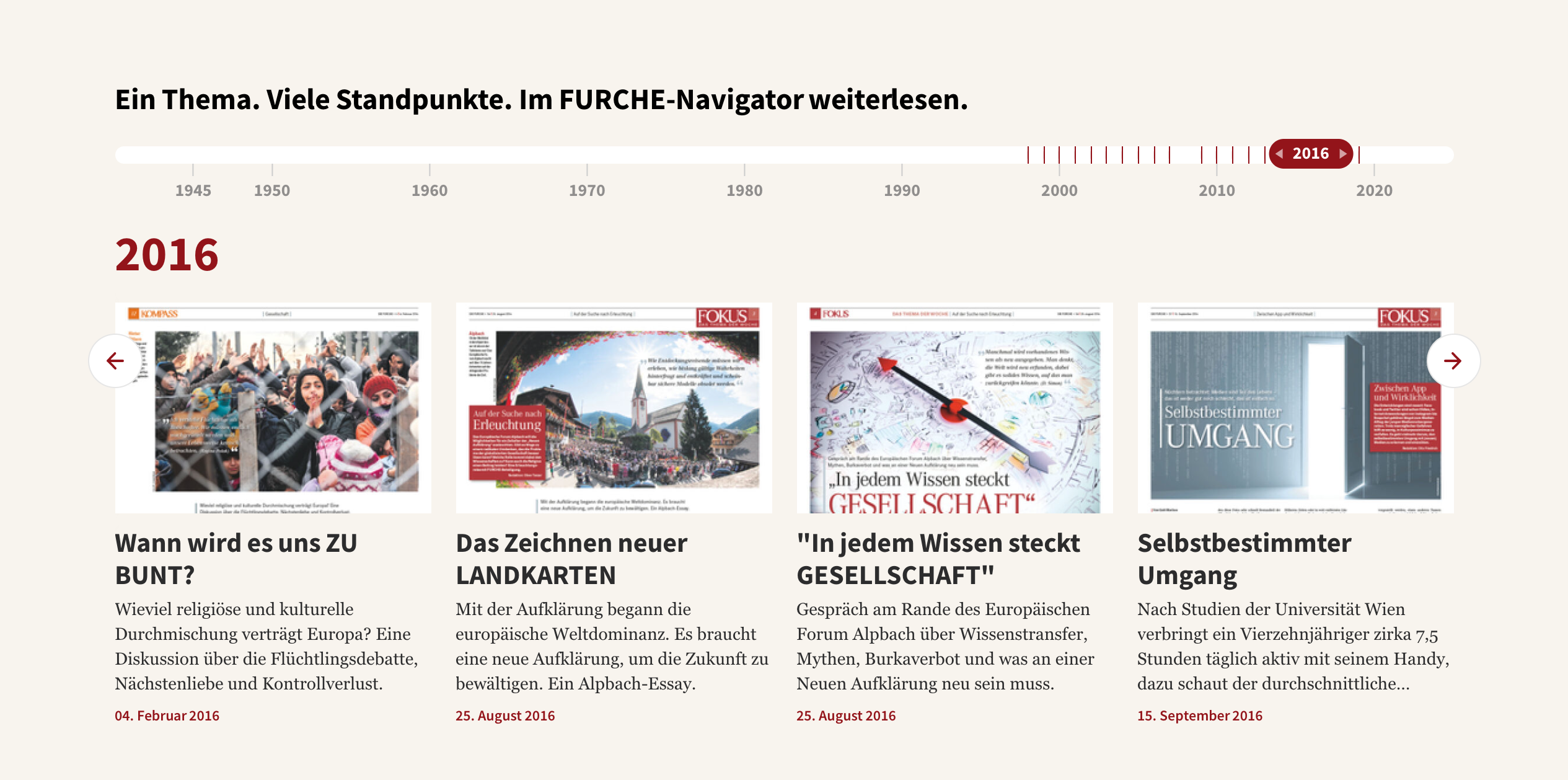
From this came the idea of a timeline. It now lives under every article on www.furche.at. Affectionately called "Navigator" by the editorial team, the semantic layer lets readers travel into the past on any topic and watch how the discussion has developed. A fascinating reading experiment that no-one at Die Furche wants to be without today.
The technology in play
STRG.behave: meaning over keywords
Technically the project was built on the research outcomes of our STRG.behave project — and is still operated with it today. STRG.behave measures and vectorises every new article and assembles a dynamic timeline of archive articles that match. The editorial team has an interface to add or exclude articles manually. We advise against interfering with the semantic logic — manual edits are weighted very heavily in the self-learning system and significantly alter results. The timeline is built by a neural network. The whole system runs on Google Cloud.
STRG.behave grew out of a research project asking how media can measure their users' real interests without depending on third-party providers. The idea is that most of that third-party data is of extremely low quality and rarely makes sense. No neural network, however good, can fix that. To make this work we had to implement semantic analyses that go far beyond keyword finding — analysing sentiment and computing the actual meaning of long-form stories.
Technology details
BERT, cosine similarity, evolutionary algorithms
When we built the project in 2018 we used BERT as the embedding algorithm. Content proximity was computed via cosine similarity — content represented as vectors in high-dimensional mathematical spaces. We also use this technology for recommendations. The challenge there is that we need a blend of semantic similarity and an adaptation to the user's interests. Those considerations led us deep into behavioural economics. Ultimately we encoded a set of those principles in evolutionary algorithms — to make STRG.behave possible.
The base technology for Die Furche is our semantic STRG.cms platform. Content is created and maintained there. Thanks to semantic embedding and STRG.behave, the editorial team can produce automated dossiers — ensuring historically grounded coverage of specific topic areas.
The result
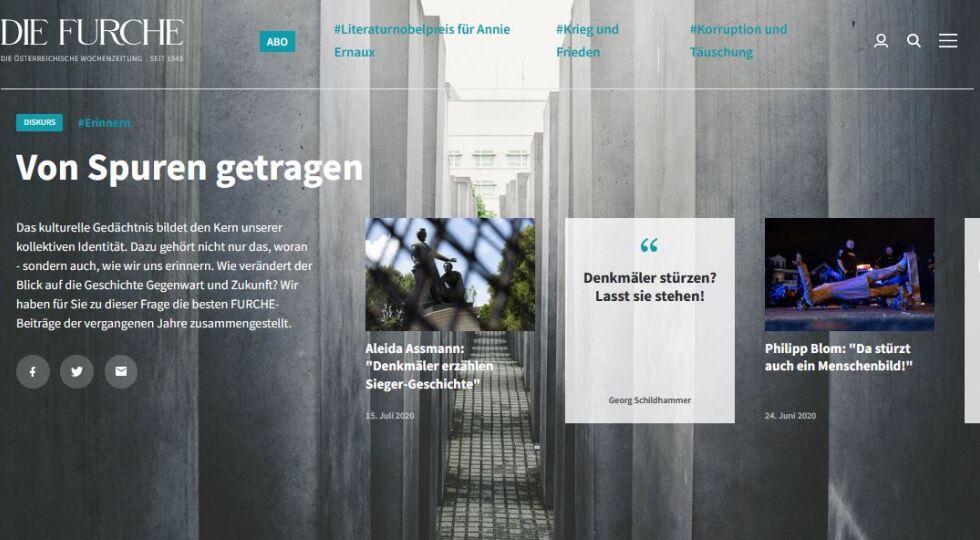
The Furche Navigator
The result is a timeline under every article that lets readers travel back to the Furche's founding in 1945. It makes visible how terms like "terror", "education", or "artificial intelligence" have changed in meaning over time — and how they keep evolving. Read a piece on the challenges of generative AI in education today, scroll the timeline back to the 60s and 70s, and you land on the debates about the arrival of pocket calculators in the classroom. You also find content on the famous Dartmouth Summer of Artificial Intelligence Conference from 1956.
Impact
What the embedding moves
- 150k+
Articles embedded
The Furche archive since 1945, semantically opened up.
- 1945
Archive depth
A time machine back to the founding under every article.
- BERT
Meaning over keywords
Adapted in 2018 for societal discourse.
- Push
instead of pull
The archive shifts from a search to a recommendation system.
Outcomes
We met every goal we set for this project.
More than 10,000 articles from the paper's earliest years were digitised and semantically analysed. A completely new way to engage with archives was born — far removed from asking people to type dull queries into a search field. An archive becomes a push system instead of a pull system. The history of the medium becomes alive, and readers of Die Furche experience a visit very positively.
Magazine
Mehr zu Semantik



Let's talk about your project
Want to bring your archive back to life?
We help publishers semantically embed archive content, link it to current coverage, and ship it as productive reader experiences.