

SERVICE
STRG.answer
SEARCH
Full-text + phonetic + semantic
CHAT
Dialogue with context
ANSWER
Sourced from your content

STRG.answer · Search and chat in one

Search that understands. Chat that answers.

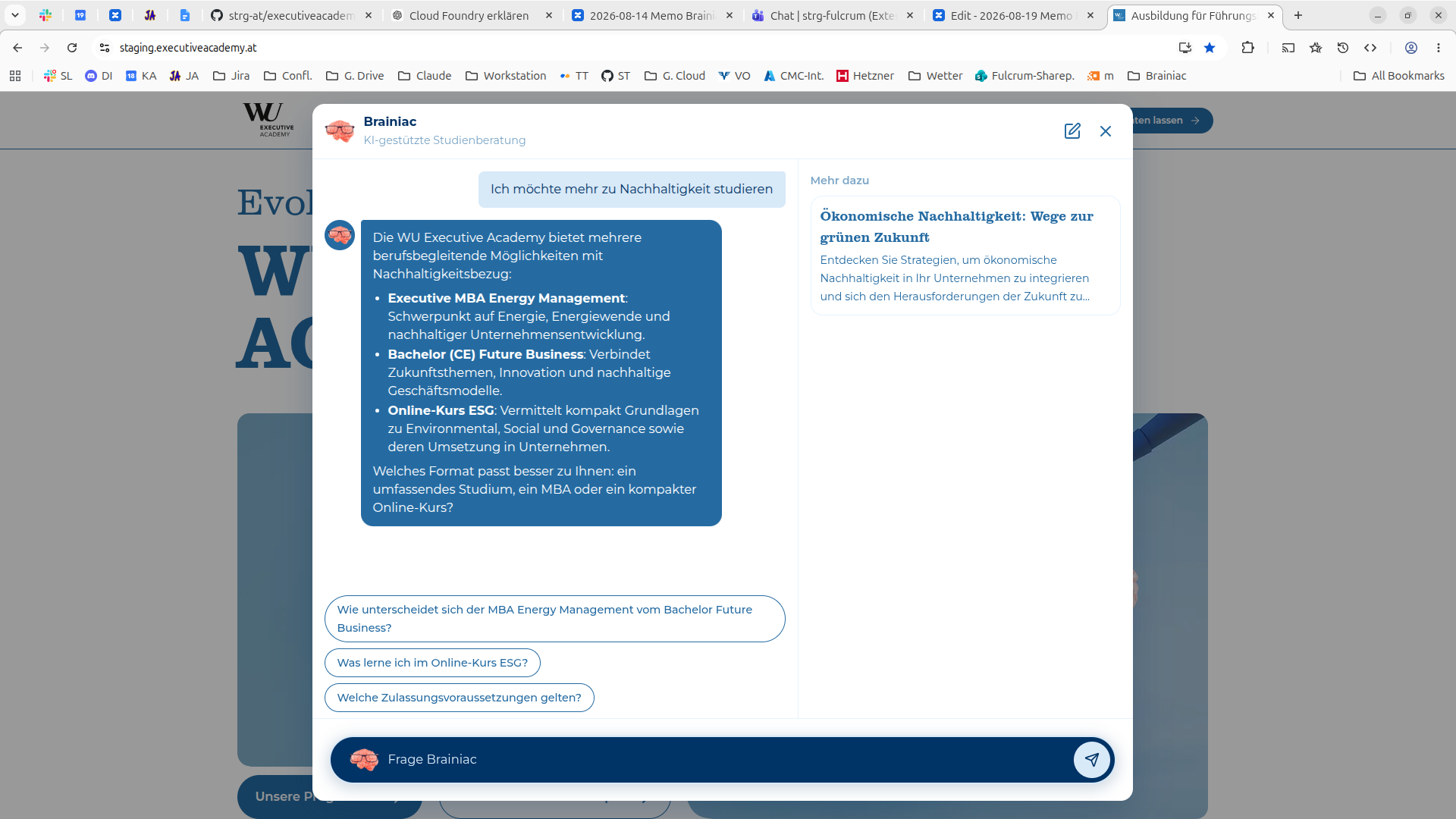
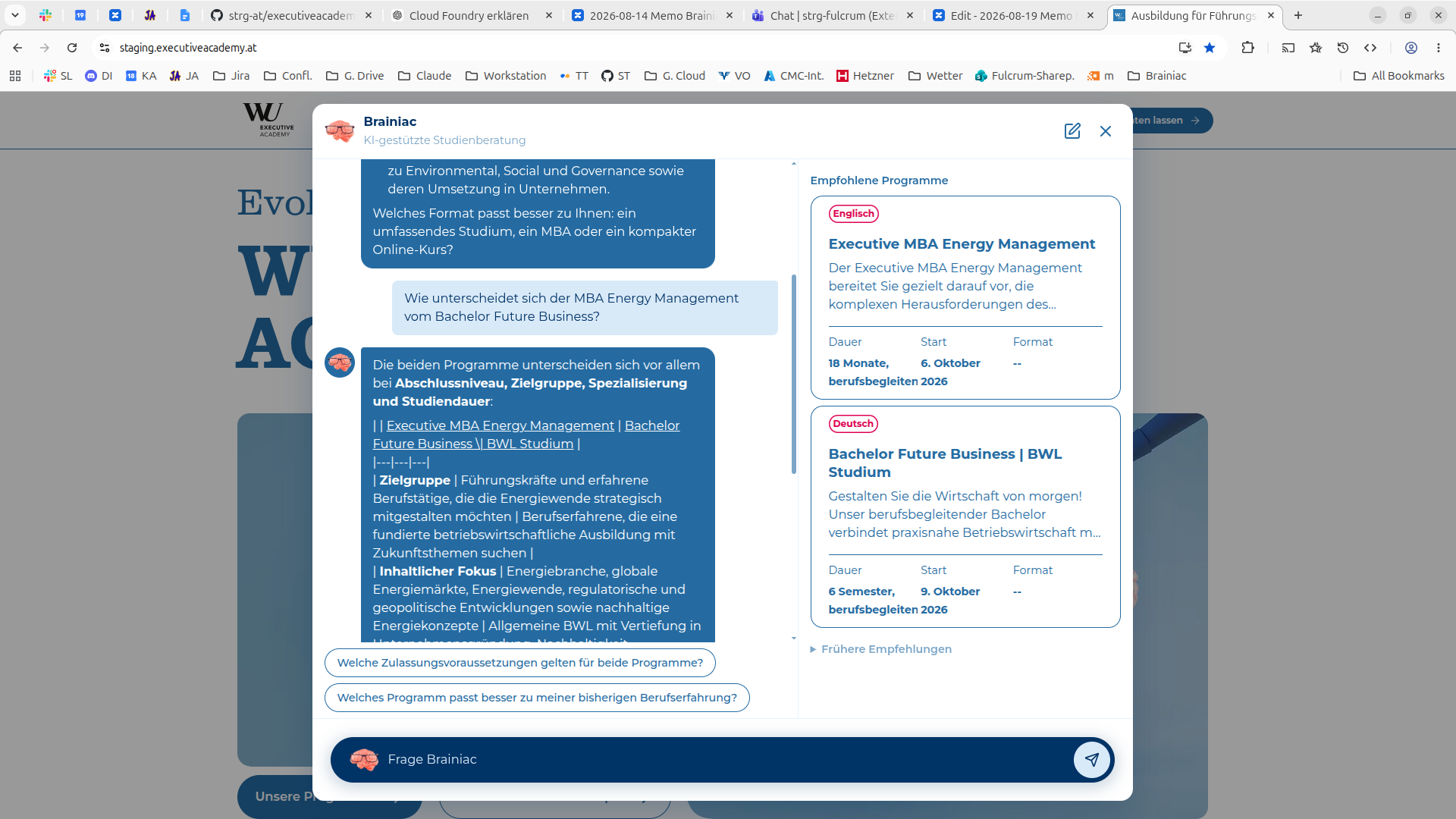
Visitors ask in full sentences, your full-text search demands exact words. STRG.answer answers the same query twice over: a sourced answer from your content, and the matching results next to it. Your team reads along on every conversation and can take it over.

Schematische Darstellung der semantischen Index- und Antwortschicht von STRG.answer
2023
In production since
EU
Data residency and operations
CMS-agnostic
Storyblok, TYPO3, WordPress, AEM

The query

Three paths, one answer.

A query does not run one path after another; it runs three at once. Only what all three bring back goes to the language model as context.

A question in full sentences

  1. 01

    Full text

    Exact matching for product numbers, proper names and abbreviations, where every character counts.

  2. 02

    Phonetic

    Typos and name variants that exact matching would never catch.

  3. 03

    Semantic

    What is meant rather than typed, even when no word of the question appears in the text.

A sourced answer from your own content The language model formulates exclusively from the passages found and names the source. If the index turns up nothing solid, the system says so.

The problem

Why your search is becoming a bottleneck right now.

Someone used to asking an AI a complete question no longer types two keywords into your site either. They write “Which variant is suitable for outdoor use in frost?”. Full-text search finds nothing, because none of those words appear that way in the datasheet. The visitor does not conclude that your search is bad. They conclude that you do not carry the product. The same precondition now also decides whether your content appears in generated answers beyond your website: structurally indexed and semantically understood.

How it works

From content inventory to a sourced answer.

STRG.answer does not replace your CMS and migrates nothing. We read your content through the existing interface and build a semantic index alongside it.

  1. 01

    Index

    Connected to your CMS, PIM or shop system, indexed section by section and kept up to date. The index knows not only documents but how they relate: which variant meets which specification, which article belongs to which product.

  2. 02

    Understand

    Full-text, phonetic and semantic in a single pass. Technical terms and your internal nomenclature are learned along the way instead of maintained by hand.

  3. 03

    Answer

    The language model formulates exclusively from the passages found and names the source. If the index turns up nothing solid, the system says so instead of guessing.

  4. 04

    Take further

    Alongside it, searches run against further content, products and services. Where a concrete offering fits, it is linked directly.

Chat functions

What happens in the conversation.

On your website sit visitors who do not know your range and do not speak your nomenclature. Behind it several agents work in parallel: one searches, one formulates, one checks which offering fits. Each can be configured and switched off individually.

  1. 01

    Context across the session

    The fourth question still knows what the first was about. Visitors narrow down inside the conversation instead of starting over with new keywords.

  2. 02

    Answer and results side by side

    While the answer forms, the result list fills up next to it. Every statement carries its source and is one click away in the original.

  3. 03

    Offerings in the conversation

    Where a question points to a product, a programme or a service, the answer names it and links straight there.

  4. 04

    A register that fits the question

    The system classifies the intent and tone of the question and steers the length and register of the answer with it. The same classification shows sales how far along a visitor is. Details in the FAQ under mood detection.

  5. 05

    A person takes over

    Your team can take over any running conversation. From that moment a person answers, in the same window, with no channel switch for the visitor.

The backend

The part only your team sees.

The system stands on a public website and talks to people who are not customers yet. That makes it a sales channel, and a sales channel needs a console.

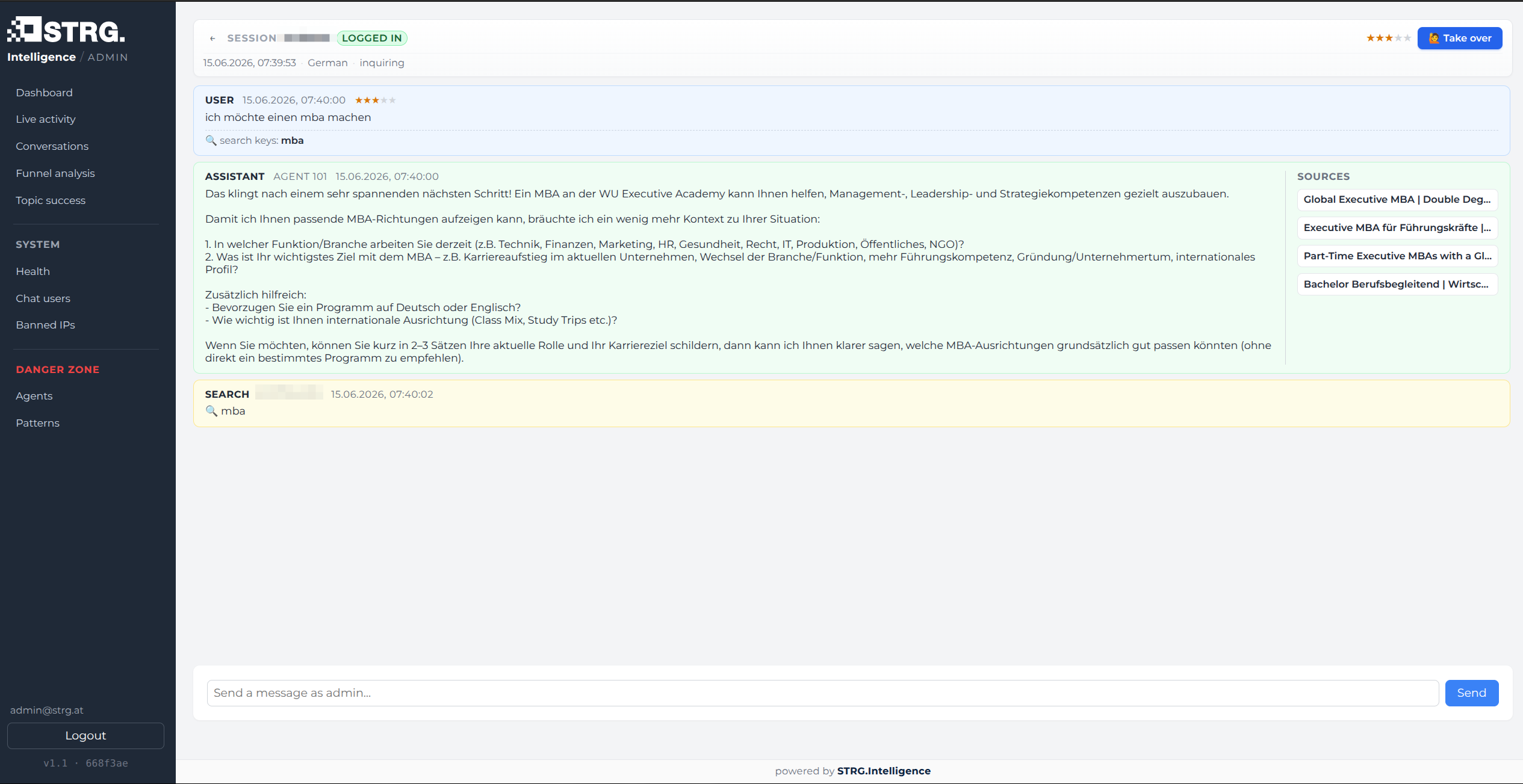
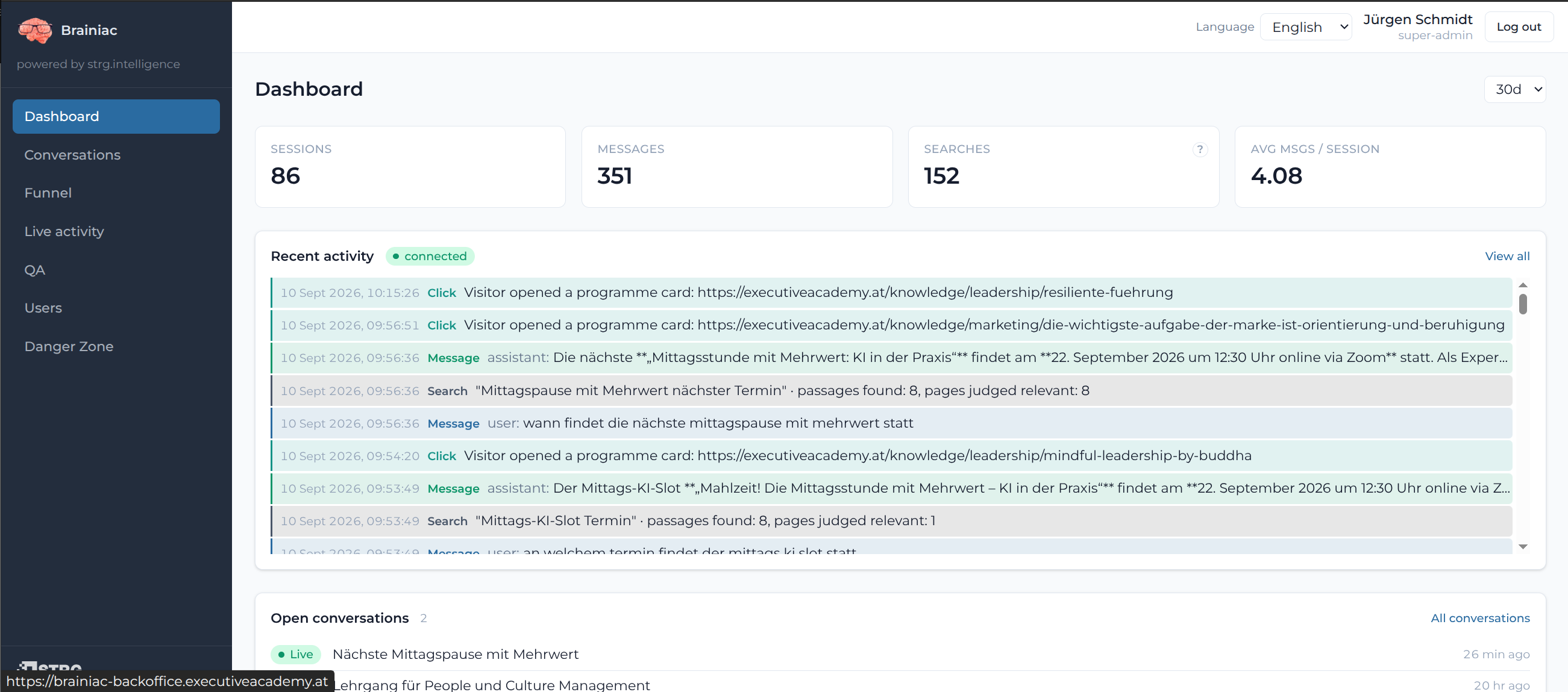
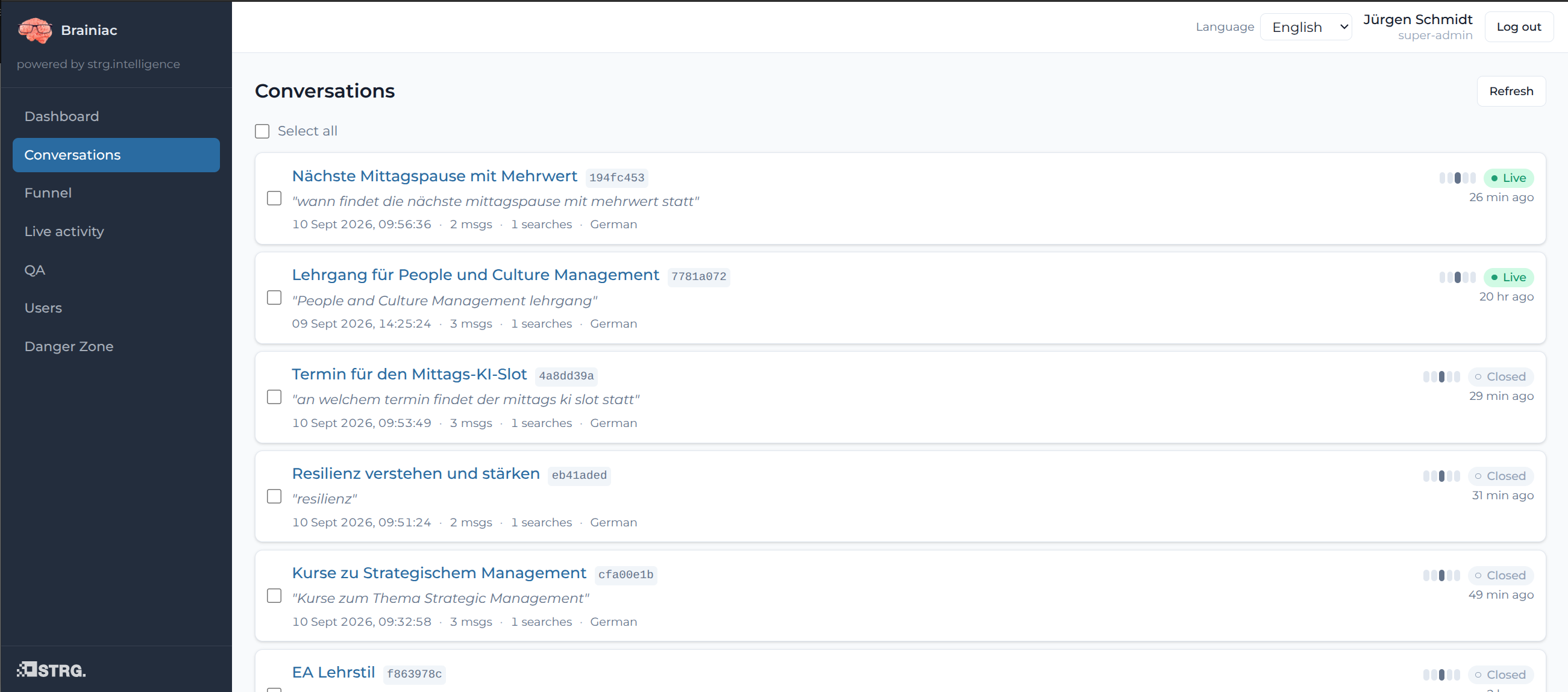
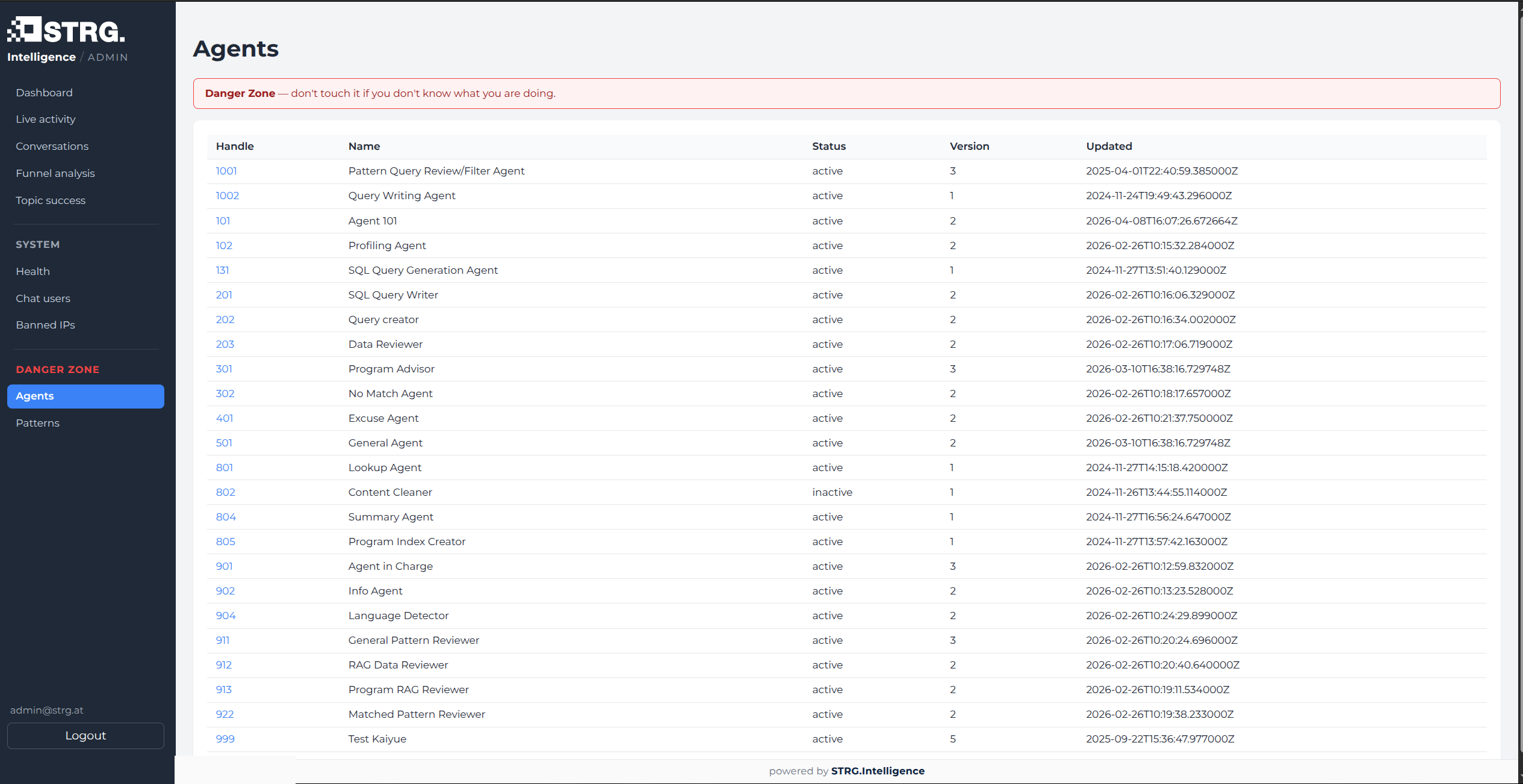
In the backoffice you steer the channel: which agents run, with which language model, and what stays switched off. Every conversation can be retraced down to the passages the answer rests on. The rest is analysis, and for a sales team that is often worth more than the search itself.

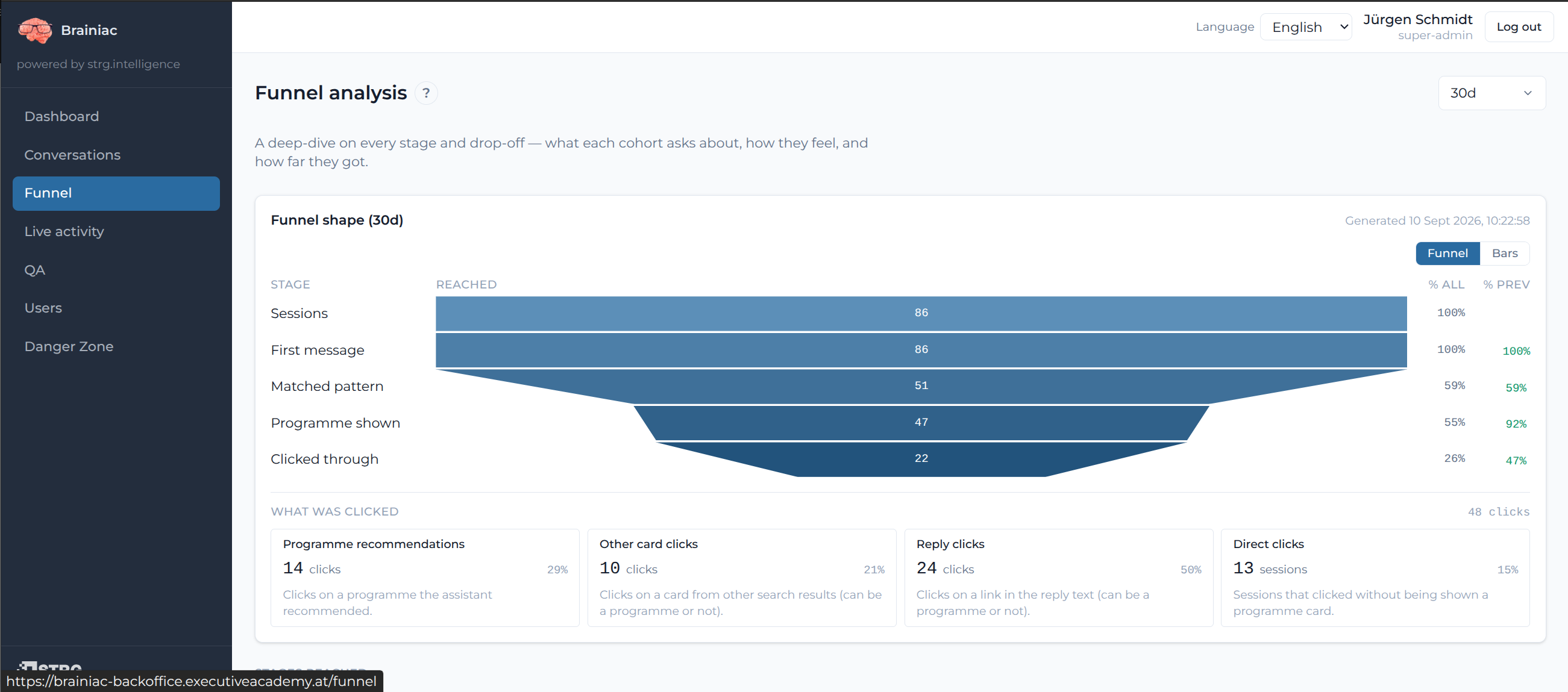
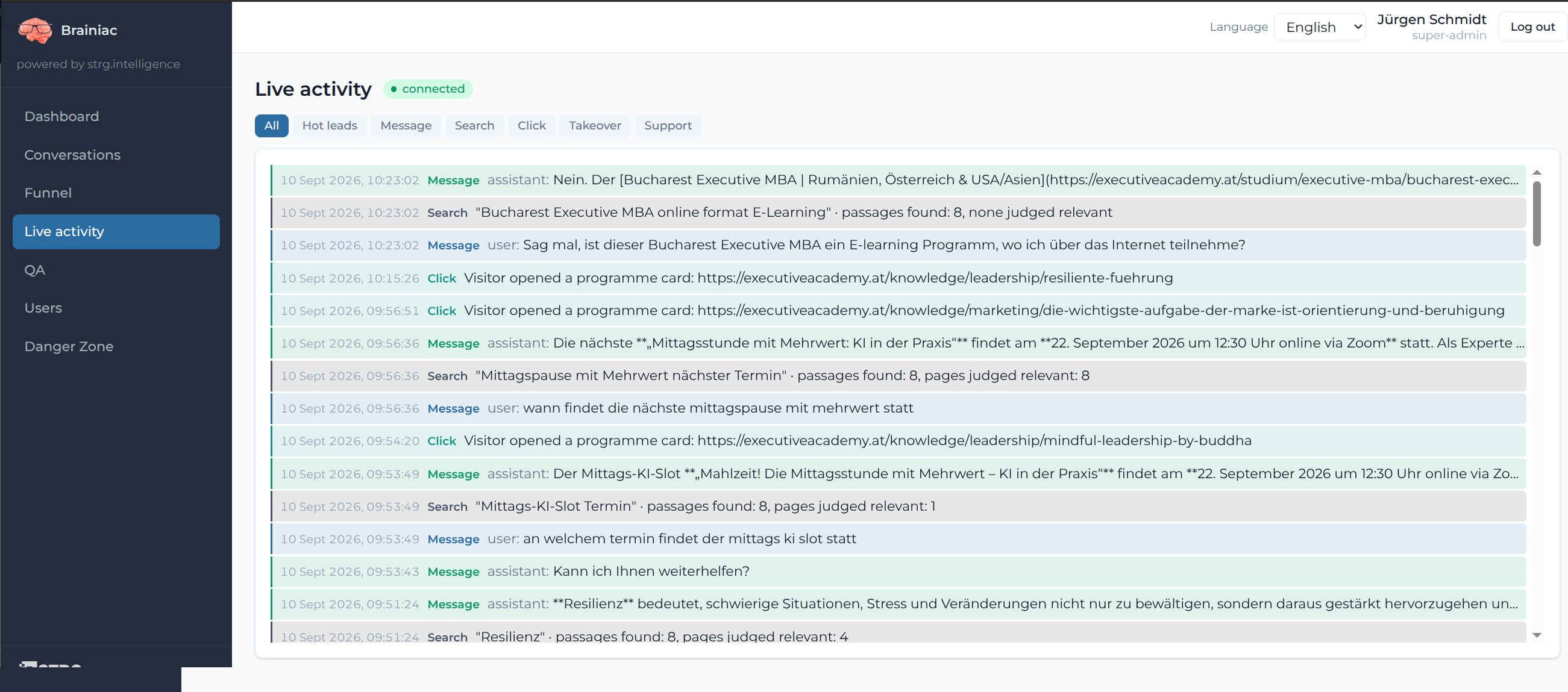
  • Dashboard: sessions, messages and queries at a glance.
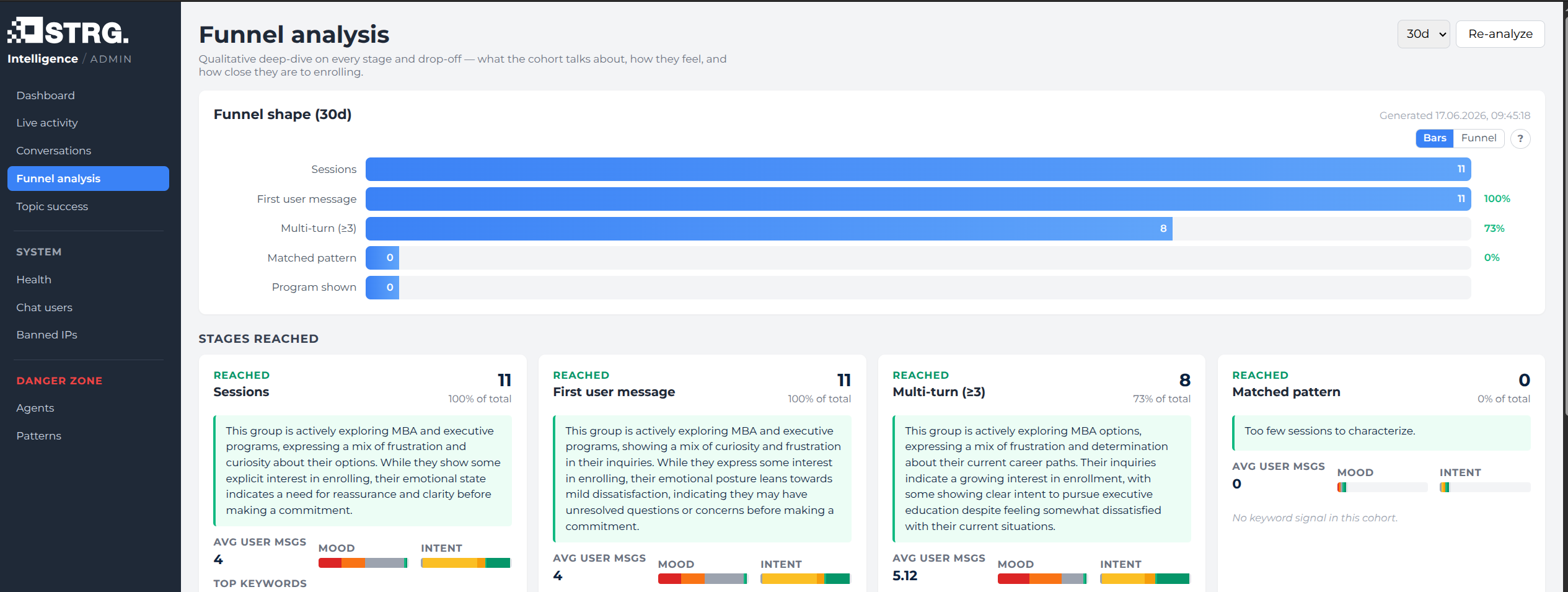
  • Funnel: from the session through the first question to the click on an offering, with the drop-off points in between.
  • Conversations by topic: what is being asked, and what no content exists for yet.
  • Takeover: your team steps into a running conversation and answers itself from there on.
  • Mood detection: intent and tone of the queries, aggregated and not tied to individuals. Can be switched off.
  • Agents: configurable and switchable individually, including the language model.

Use cases

Where STRG.answer makes the difference.

01

Media & publishing

Editorial & archive

Twenty years of articles are an asset as long as they can be opened up. Readers get the context that keeps them on the site with every article, and the archive becomes reach again.

Example question
What became of the pilot regions after the 2019 care reform?
02

Commerce & industry

E-commerce & product variants

A customer rarely knows the name of the product they need, but they know their use case. Semantic search translates use case into variant, including the specifications that only appear in the datasheet.

Example question
Which seal withstands 180 °C and oil, and fits DN 50?
03

Services & advice

Offerings that need explaining

Insurance, further education, B2B services: the prospect knows their situation, not your catalogue of offerings. The conversation turns it into a matching offering, and where it gets concrete, your team takes over.

Example question
I am an engineer, 39, and want to move into leadership. Which programme fits?

Proof

In production since 2023.

The semantic analysis algorithms come out of our STRG.behave research project (2017), optimised continuously since and extended with LLM mechanics in 2023. So not a prototype that goes under load for the first time with your project. How far that carries is clearest in the archive of the weekly newspaper Die Furche: the complete holdings since 1945, semantically located rather than sorted by keyword.

Read the Die Furche case study

Integration & operations

What introducing it actually involves.

STRG.answer is connected to your existing system, not developed into it. Proven with Storyblok, TYPO3, WordPress, Adobe Experience Manager and STRG.CMS. In the frontend there is a search and chat component that adopts your design, or you address the API directly.

  • Content audit and feasibility: what is there, and how well can it be indexed?
  • Index build and tuning
  • Pilot on a delimited section
  • Rollout and continuous optimisation

The connection

What is built beside your system.

Your content stays where it is. Beside it we build an index that is kept up to date.

  1. A

    Your inventory

    CMS, PIM or shop system, read through the existing interface or an export.

  2. B

    The index

    Indexed section by section, stored semantically, updated on every change. Operated in the EU.

  3. C

    Your frontend

    A search and chat component in your design, or your own interface straight on the API.

Research, fast content discoverability and context now decide reach.
Markus NeuwirthSenior Consultant, STRG.AT

FAQ

Frequently asked questions

What separates semantic search from a classic full-text search?
Full-text search compares character strings, the word you searched for has to appear in the document. Semantic search compares meanings, so a question about a “solution for outdoor use in frost” also finds a datasheet that says “weather-resistant down to −20 °C”. We use both in parallel, because exact matches on part numbers remain unbeatable.
Does this work with our CMS?
As a rule, yes. We connect through existing APIs or exports, with Storyblok, TYPO3, WordPress, Adobe Experience Manager and STRG.CMS among others. The precondition is not a particular system but accessible, reasonably structured content.
Can the chatbot hallucinate?
It answers exclusively from the passages the index supplies, and it names the source. If nothing solid is found, the system says so instead of constructing an answer. That does not rule out errors, but it makes them checkable.
Can someone from our team step into the conversation?
Yes. Running conversations are visible in the backoffice and your team can take over any of them. From that moment a person answers instead of the model, in the same window. The analysis shows you which conversations are worth it.
Where is our data held, and what happens to non-public content?
Operated in the EU, and your content is not used to train models. You decide which areas are indexed at all, and existing access rights from the source system are carried over: what a user may not see there appears in no answer. Which models are used we set out in writing in the data processing agreement.
How long does introduction take, and what does it cost?
A pilot on a delimited content area is usually live within a few weeks; the effort rarely sits in the technology but in content quality. Setup depends on scope and system landscape, with a running operational share by volume on top. We name the figure after the audit, not before it.
What is mood detection?
A classification of the query, not of the person. The system estimates the tone and intent of the question typed in and steers the length and register of the answer with it; the same classification is reported in aggregate in the backoffice. Only the text of the query is evaluated: no emotion recognition via image, voice or biometric traits, no profile of an individual. Because the EU AI Act regulates emotion recognition specifically, we describe it here explicitly. Can be switched off.

Read about semantic search in STRG.Magazine

STRG.magazine

Next step

See it running on your own content.

We take a delimited part of your content, index it and show you what the system answers with it and where your content has gaps. Not a pitch deck, but your data in a running search.