
Artificial intelligence can predict a great deal, but often cannot explain why something happens. This is exactly where causal AI comes in. On 10. April 2026, the Social Artificial Intelligence Night 2026(SAINT) at the University of Applied Sciences St. Pölten once again became the meeting point for everyone working on real-world applications of artificial intelligence. Under the motto „Beyond the Paper: Real-World AI in Action“ the event clearly showed how AI is moving from research into industrial and societal practice. As a partner of the event, it was particularly valuable for us to experience the diverse perspectives from science and industry first-hand and to be an active part of this exchange.
From prediction to understanding: causal AI in focus
One topic that is particularly relevant and still receives too little attention is causal AI. This was the starting point for the presentation by Lilli Joppien and Lisa Latzelsperger from STRG picked up this point. Under the title „From Data to Decisions: Applications of Causal AI in Industrial Contexts“ they showed why classic AI approaches reach their limits in many business scenarios.
While many business intelligence and AI systems are excellent at making predictions, they often lack an understanding of:
cause-and-effect relationships
What happens when we actively intervene?
How do external factors change the result?
AI that truly supports decisions
Causal AI puts one of the key questions of modern data analysis at the center. Why does something happen and what happens if we intervene in a targeted way? Instead of limiting itself to pure pattern recognition, it aims to understand and make usable real cause-and-effect relationships. This places it at the intersection of three central forms of analysis. It explains the past (diagnostic), anticipates the future (predictive) and derives concrete actions (prescriptive). An example that many people already know makes this challenge tangible. Ice cream sales and shark attacks show strikingly similar patterns over the course of the year. A classic AI quickly identifies a strong relationship here and risks drawing the wrong conclusions. Only by including the underlying influencing factors does it become clear that both developments depend on a common cause. This is precisely where the decisive added value for companies lies.
With STRG.reason (specific use cases are available here) a system was developed for exactly this purpose, supporting companies in understanding complex relationships. It combines historical data with external influencing factors and makes it possible to simulate targeted interventions, such as price changes, process adjustments or strategic decisions.
This creates a new type of AI use that truly supports decisions. Instead of only delivering forecasts, it shows concrete courses of action and their likely effects. This makes it particularly valuable in industrial contexts, where every decision has real consequences, whether in production, supply chains or the market. More on this in our article on industrial AI applications.
More images from the event are available in the SAINT archive.
This year’s edition of SAINT made clear where AI is currently heading. Away from pure models and toward concrete, scalable applications. A central highlight was the keynote by Loubna Ben Allal, Machine Learning Engineer and head of the SmolLM project at Hugging Face , who gave valuable insights into efficient training of language models. Her focus on compact, resource-efficient models showed that powerful AI does not necessarily require huge infrastructures.
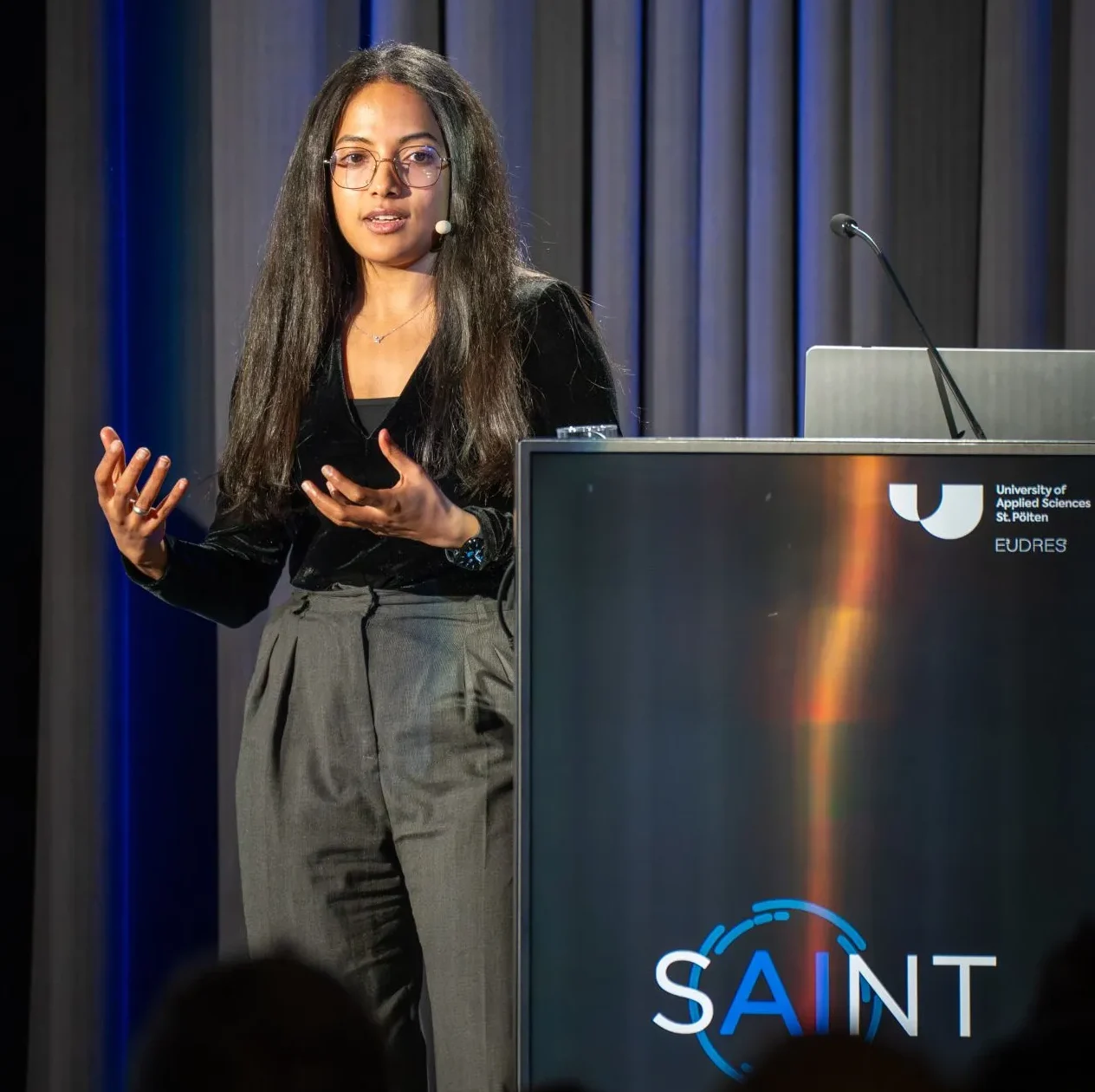
© SAINT 2026, University of Applied Sciences St. Pölten
A meeting point for the AI community
The presentation by Lilli and Lisa on causal AI was only one part of an overall highly varied program. The SAINT 2026 showed a broad range of relevant topics: from efficient training of modern language models and synthetic data for computer vision through to autonomous drones, trustworthy foundation models and questions around compliance and digital sovereignty. It was precisely this mix of technical deep dives and practice-oriented applications that made the event particularly compelling. Between the sessions, the breaks also provided sufficient space for exchange, discussions and new perspectives.
Source: LinkedIn, Social Artificial Intelligence Night (SAINT), 2026.
For us as a long-standing partner, the SAINT was therefore far more than a conference. It is a platform that makes visible how AI is making the step from research into real applications and where exactly the topics that will shape the future of the industry are emerging.