

For the first time in two years, STRG Managing Director Jürgen Schmidt took the stage again and delivered a keynote at JETZT Summit 2022 – an Austrian digital marketing conference for regional professionals. Once again, he demonstrated a natural talent for explaining complex technological concepts in a way that enabled the audience to grasp the creative potential behind the technical buzzwords.
JETZT Summit and Jürgen Schmidt share more than just the same initials: JETZT Summit is an annual conference for digital marketing professionals, while Jürgen Schmidt is CEO of a company that develops AI-driven technology solutions for the digital media industry. On closer inspection, however, you will notice a few differences. The very name of the conference, JETZT, describes its scope: According to the website, JETZT is dedicated to „the constantly changing framework conditions, the ever-new challenges and numerous best practices in digital marketing, digital advertising and digital media“. In other words: the currentState-of-the-Art Trends (and perhaps those of the near future). Jürgen and STRG, on the other hand, focus on the potential of complex deep technology for digital media. Not only now or over the next two years, but up to a decade into the future. For STRG, „Deep Tech“ is not just a buzzword describing something still far off on the horizon. Rather, it is already the driving force behind a new generation of MarTech and will remain so in the future – but only if it is understood for what it actually is.
„Deep Tech is not just a buzzword describing something on the distant horizon. It is the driving force behind a new generation of MarTech!“
On April 5 and 6, 2022, the second annual JETZT Summit conference took place, though it was the first one „in real life“. Because of the coronavirus pandemic, last year’s premiere was held entirely online. This year, 270 marketing, advertising and media professionals from the DACH region gathered in Wien to share their know-how in keynotes, best-case anecdotes and panel discussions by 70 renowned speakers. For the second year in a row, Jürgen was invited to give a keynote speech on the opening day. Last year, he introduced many in the audience to the basic concepts of data-driven publishing. This year, he went one step further, diving deep into the mathematics and constraints that shape the hottest topics in MarTech.
„JETZT“ is really a marketing conference, so hardly anyone there has any real understanding of Deep technology“, Jürgen claims with a touch of exaggeration. „I give talks like this to teach people something, because I think to be creative in technology, you have to understand the technology, otherwise you are just repeating the same old things. People keep talking about third-party cookies or arguing about the pros and cons of Facebook and Google without being able to imagine what else might be possible!“ Jürgen’s 45-minute talk was titled „Five Technologies That Change the World“. Across 59 slides, a veritable barrage of complex terms and concepts was unleashed, perhaps leaving some audience members a little shocked, but that was intentional. „Most marketing professionals only attend marketing conferences“, Jürgen says, „ (…) so I give them the content that is not usually covered. The reverse is also true – most technologists only go to developer conferences and do not think about whom or what the technology is being used for. I see my role as building bridges and fostering understanding between these mindsets, helping both marketers and developers become more creative in their work.“
„I see my role as building bridges and fostering understanding between these mindsets, helping both marketers and developers become more creative in their work.“
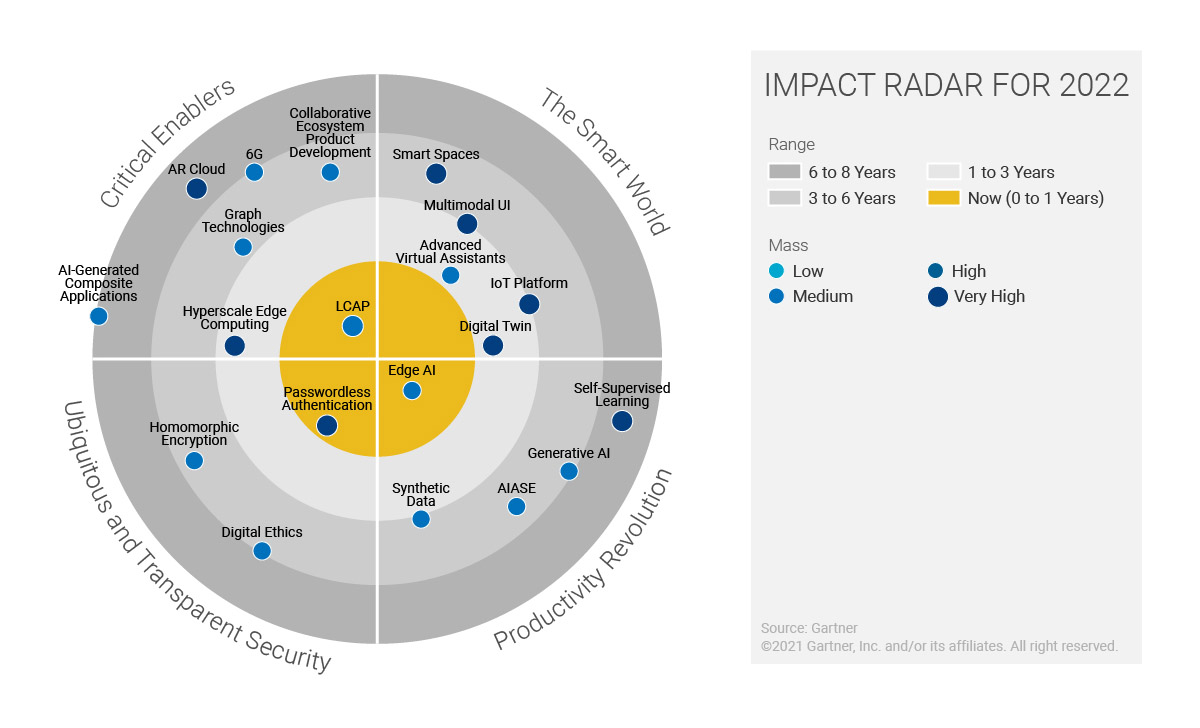
One slide showed Gartner’s „Impact Radar for 2022“ and helped the audience get to know a few buzzwords they will certainly be using in the future: „Multimodal user interface“, „Generative AI“, „Homomorphic encryption“, „Self-Supervised Learning“. Jürgen used this as a starting point to talk about **four key technologies* that are changing the world of digital media: genetic algorithms, neural networks, Data Science and Cloud Services.**Jürgen urged the audience not just to memorize these terms, but to understand the creative potential they unlock.
The problem in digital marketing is that many people use the right buzzwords, but do not understand what they actually mean. That is why they will never work creatively with the technology and never find out how the individual pieces of the puzzle fit together. As long as you are satisfied with buzzwords, you will not make progress.For example, the names of the technologies that enable user tracking and targeting have changed over the past three decades, but the technology behind them is the same as ever. It actually has little to do with AI, neural networks, semantic analysis, NLP, machine learning, data science, evolutionary algorithms and the other buzzwords circulating in MarTech.
„When people in digital marketing boast that they use neural networks and so on, they are not really doing that. You do not need a neural network to achieve what most of them are doing“, Jürgen protests. „For example, when we launched the Salzburger Nachrichten digital platform five years ago, we published an article about how we had created the first portal in Austria to use AI for tracking user behavior and serving tailored content. „This woman from another news portal replied: ‘Fake News!We have been doing that for 15 years.'But anyone who knows technology knows that this would not have been possible – at the time, neither the required hardware nor the framework conditions existed. Sure, you could always perform keyword tagging and simple text-string analyses to generate linked content, but from a technologist’s point of view, that is really outdated, rule-based stuff.“
A not quite so amusing example illustrates how much semantic analysis has evolved over the past 20 years:
When the tsunami devastated several countries in the Indian Ocean in 2004 and killed almost 230,000 people, some portals automatically suggested articles about and advertisements for Indonesian tourism. The software matched the text strings correctly (beach/ Indian Ocean/ waves), but did not interpret the troubling context behind the content.
Even today, such rule-based decisions still determine which users are served which content and marketing measures. If the weather is sunny and warm, it is fine to run an ad for a restaurant with outdoor seating, but not when it is raining. „You do not need AI for that“, says Jürgen. „That has nothing to do with data science or deep tech. It is even worse when it comes to typical demographic groupings – people’s interests and behaviours do not always fit neatly into the typical categories of age, gender, education, class, and place of residence.“ Just because you are a Viennese person in your 20s who once clicked on an article about an artisanal bakery does not necessarily mean you are a bobo who buys their clothes in a second-hand shop.
“Real” AI makes it possible to analyse data at a much deeper level than simply identifying similar text strings or tags and classifying them according to a predefined set of rules. Instead, the AI learns the rules of the game by itself – much like a child learns language through constant trial and error – and in doing so recognises common patterns in a vast universe of data. Neural networks and machine learning methods can predict trends in (constantly changing) human interest without being influenced or constrained by rules defined by humans. AI algorithms optimise themselves and find connections that no one suspects could exist.

If all of this still sounds like a lot of incomprehensible technical jargon, don’t panic! „STRG is not a digital marketing agency, but a technological interface for the digital media sector“, Jürgen reassures us. STRG is here to advise and support you. We do not simply hand you a set of new buzzwords; we give you a fundamental understanding of these terms and underpin it with the expertise that will help your company grow.
*So, Jürgen, what is the fifth world-changing technology? „Warp drive, of course!“ You know, the distortion of the space-time curve to travel faster than the speed of light? Well, maybe. Even though Captain Kirk has finally made it into suborbital space with Bezos’ Blue Origin, he may still have to wait a little longer to “boldly go where no man has gone before” 😉