

About TED AI:TED.AI is an event within the framework of the international TED conferences. TED stands for Technology, Entertainment and Design. TED.AI is a special edition on the topic of Artificial Intelligence and was held in Europe for the first time in 2024. TED takes a critical look at a range of topics relating to science, entrepreneurship, activism and art. The original conference was first held in 1984.
Since 1990, the TED-Conference) has taken place annually, over four days in Vancouver.
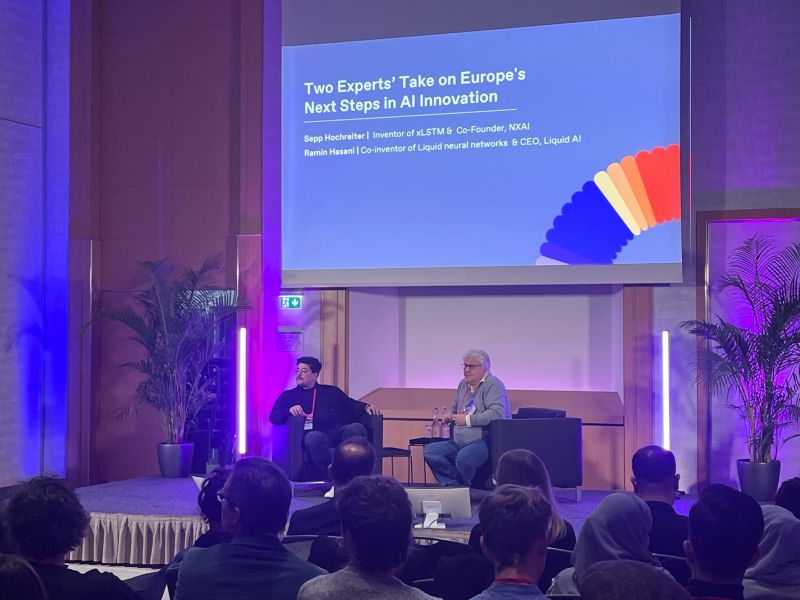
I admit, I am a big fan of Sepp Hochreiter. I find his work simply brilliant, and he was incredibly early with it. Hochreiter wrote his foundational work on LSTM ([Long-Short Term Memory](https://de.wikipedia.org/wiki/Longshort-termmemory)) back in the 90s, laying one of the essential foundations for the later development of Transformer architectures. This could also have been done in the 90s of the last century, but back then we did not yet have the computing capacity. What I did not know was that Sepp wrote his diploma thesis under another luminary of the AI scene, Jürgen Schmidhuber. The German researcher, who now works in Switzerland, set out three essential principles in a paper in 1991. (1) AI can be generative if it is (2) pre-trained with data and the decision about the next word in the sentence is defined via (3) probability calculations and an attention model. Does that remind you of something? Exactly, that is the basic principle of GPT ([Generative Pretrained Transformer](https://en.wikipedia.org/wiki/Generativepre-trainedtransformer)). In any case, it was great to hear Sepp Hochreiter in a discussion with the much younger mind behind Liquid Neural Networks, Ramin Hasani. What also truly fascinated me was my first impression of the audience at TED.AI. The topics the two discussed were really not trivial, and the questions and the discussion with the audience impressed me. A hall full of mathematicians? In any case, people who had engaged with AI far more intensively and in far greater depth than by submitting a few prompts to chatGPT or generating cat images for social media.
In a later panel that Friday, I had the opportunity to hear Selena Deckelmann in a panel discussion. She leads the use of AI at the Wikimedia Foundation. On Saturday, she gave a detailed TED Talk on the subject. She explained the democratic methods by which Wikipedia texts are created. That is already a good thing in itself. Even better is that most of today’s active language models use this data for their training. Texts created according to a largely democratic system and a project that exists outside our economic system (or is at least non-commercial) serve as the basis for the major LLMs. This also allows for a very positive view of the future of AI. And this future will bring very profound changes.
A well-known publisher and journalist recently said to me in a conversation, “you have been telling us for 10 years that the newspaper has had its day – you were wrong, people want printed paper”. It left me speechless. We are looking for the future of an industry suffering from a severe crisis in that industry’s past. You have the opportunity to transform. If you do not, disruption will come. Other market participants will take over the business, and journalism will find new paths. We have seen effects like this in many other areas as well. I have often said at conferences that at the beginning of the last century there was no carriage manufacturer that managed to build cars. Perhaps today’s automotive industry should look at this momentum. Our entire continent depends on the fact that people have a need for mobility, and this mobility is subject to massive change. The need will not disappear; whether the existing industry will manage the changes or whether new market participants will emerge depends above all on whether disruption can be prevented through transformation – deep and very far-reaching transformation.
That brings me to the wonderful feeling that over the days at TED.AI I did not have to have a single conversation about fear of disruption or fear of technology. Of course, many people are concerned about how the development of AI will affect society. At TED.AI, we heard the architect of the European AI Act, Gabrielle Mazzini. The reactions to it were decidedly positive. An interesting momentum I was able to take away from a casual conversation during a break was this: We use the AI Act as an excuse for not being able to innovate – a European phenomenon. The AI Act is not even in force yet and is already being used as a reason why, in the commercial development and application of AI, we are not really bringing much to market. What we lack here is entrepreneurial courage. It is not politics that is failing here, it is the entrepreneurs. Few companies, as the CEO of Aleph Alpha, Jonas Andrulis, told us, are truly active in foundational development. That reminded me of a conversation I recently had with a representative of the Fraunhofer Institute in Berlin. They will now also receive one (!) NVIDIA computer there in order to compute models. The META Group has 80.000 of them. Perhaps we can read Europe’s courage to innovate from this ratio of numbers.
My memories of TED.AI take me here to a very interesting TED Talk by Rama Akkiruja, the VP for automation at NVIDIA. In the European context, the company NVIDIA was hardly known to anyone, apart from gamers who cared about GPUs. But the current AI hype made NVIDIA the most valuable company in the world. In doing so, the company followed the well-known principle: “In times of gold-rush sentiment, you have to sell shovels”. Do you know btw. which country on this planet has benefited most from the international AI hype? Exactly, of course you knew. It is the Caribbean island of Anguilla. The country was able to increase its GDP by 13%. Exactly, by selling the TLD (top-level domain) .ai. Also someone who recognized that selling shovels can make a good deal of sense, even if in this case it probably happened by chance. On a trip through the Caribbean in winter 2024, we sailed to Anguilla specifically for this. I absolutely wanted to set foot on this ground. The country worldwide whose economic output AI has contributed to the most does not even have a jetty for mooring. You can only anchor off the coast and go ashore by dinghy. The immigration office is right on the beach. Reggae sound comes from large speakers. The island has twice as many inhabitants (approx. 13.000) as Eichgraben, the village where I live. At TED.AI, we discussed inclusion and exclusion in this comprehensive transformation at length. We weighed risks and opportunities, and we looked for solutions to AI’s enormous resource consumption. I also loved this aspect of TED.AI. A critical perspective, no self-absorbed tech euphoria, and still an optimism that allows us to maintain a positive view of the future and the development of AI. Shaolei Ren (UC Riverside) explained the global water demand triggered by every single request to an LLM, varying slightly by continent. With one liter of water, we can process approx. 60 requests to a Large Language Model. We currently have thousands of requests per second. We can all do the math ourselves.
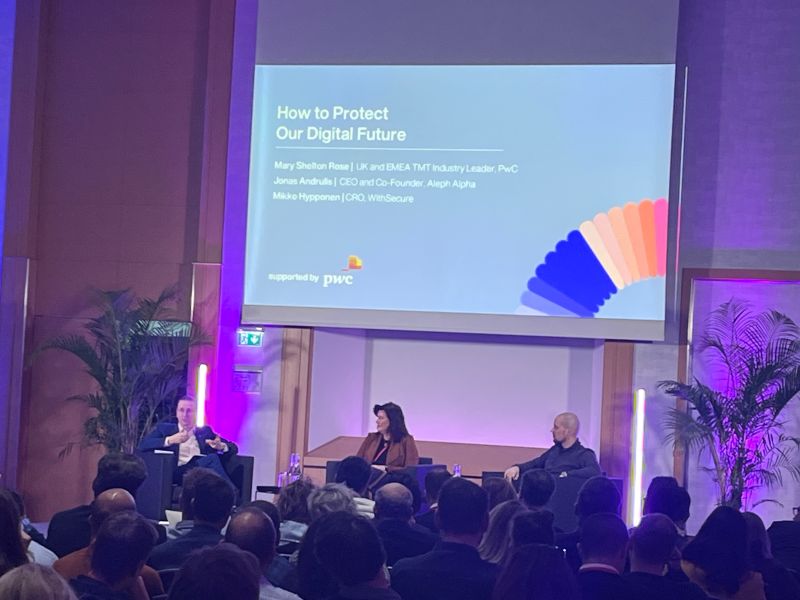
How do we secure our digital future? Can machines take power? Is the Matrix real? The End of the World – as we know it? The discussions about the dangers of AI are important. They are an existential component of a meaningful debate. A discussion about where we use AI, what we will do with this ingenious technology. Several panels and many TED Talks addressed this issue. But despite all the fears, all the concerns, I was particularly pleased by this sentence:
We heard Ramin Hasani, the co-founder and CEO of Liquid.ai. Ramin spoke about the new possibilities and the drastic reduction in resource consumption through his (co-)idea of a Liquid Foundation Model. During the talk, we were allowed to play with the Playground. But Murphy’s Law struck mercilessly. When a large share of the 1000 listeners opened the Playground, the system gave up and collapsed. But Ramin did not lose heart. Here we see generative AI that no longer uses a transformer model. Another great step toward the future. Also Microsoft is asking how the quality of LLMs can be improved. We got to see the first publicly presented visualization of Causal Transformer models in the gaming sector. Models that can adapt themselves and respond to the unforeseen. Presented as a game, with a little imagination you could get a sense of what will be possible with it. And we later saw that live in robotics. How the simplest models with 7 (in words seven) attributes can respond to events that, by their logic, cannot actually occur. Only recently I myself took an intensive look at the topic of self-correction in language models . What struck me here was that openAI is very guarded about how they actually do it and DeepMind makes a whole bundle of documents on the subject publicly available.
We can play with AI, we can generate texts and create images for social media. But we can also address relevant societal problems. One topic that was discussed very broadly at TED.AI was the impact of climate change on society and on our lives. DeepMind is working intensively on creating predictions for weather and climate models. GenCast, for example, a model that makes it possible to identify major weather phenomena much earlier in order to give people more time. But climate change was also a central topic in many other panels and talks. I am a big fan of DeepMind. I read the book by Mustafa Suleyman – The Coming Wave – with enthusiasm and have followed the history of DeepMind since its founding in 2010. In 2014, the British company was acquired by Google . To this day, however, research is conducted primarily in London. DeepMind mastered one of the greatest intellectual challenges there had been in AI development to date. In 2016, DeepMind beat the world champion Lee Sedol at the game of GO. 200 million people in Asia watched these games live on screens. In Europe, the success received little attention. Lee Sedol said that he was not playing for himself and, in this case, not for South Korea either. He was playing for humanity, to demonstrate our superiority. Lee Sedol lost the match 4:1. What is special about this victory is noted in Suleyman’s book almost in passing. The game GO requires intuition. It is not a completely logical game.
DeepMind is still active in research today. We heard from the organization’s head of research Raia Hadsell. She told us how, at DeepMind, based on the AI models available within the company, they had come up with the idea of breaking down the problem of protein folding as one of the greatest remaining mysteries of the natural sciences. To date, with the AlphaFold project, DeepMind has succeeded in decoding 200 million proteins. Two million scientists and researchers in 190 countries use the database and are working on entirely new medical possibilities, treatments and many other fields for which we need a fundamentally different understanding of our laws of nature. (alphafold.ebi.ac.uk)
I have one more in my completely subjective list, which I have selected here to talk about. Thomas Dohmke, in his capacity as CEO at Github told us in a conversation with Vlad Gozman (one of the organizers behind TED.AI Vienna) how he came from being an open-source developer to mobile apps via the SDKs from Apple and Google. And how the world of [Open Source](https://de.wikipedia.org/wiki/OpenSource)_and open access to code increasingly fascinated him, and he is convinced that a future world will need much more code – and open research. He explained why Github advocated the use of GenAI in software development very early on and how this has changed the requirements placed on developers. And yes, you guessed it, those requirements are becoming higher. We will need increasingly better programmers to handle the radically rising demand for, and benefit of, code.
The team around Alina Nikolaou and Vlad Gozman has put together an TED.AI Vienna incredible conference. An event with many breathtaking moments, critical viewpoints, outstanding developments and thought-provoking future scenarios. The TED Talks began on Saturday at 09:30 and ended at 21:30. I did not see anyone getting tired; we all stayed focused. And with Chris Turner, the live rapper, we also had plenty to laugh about.
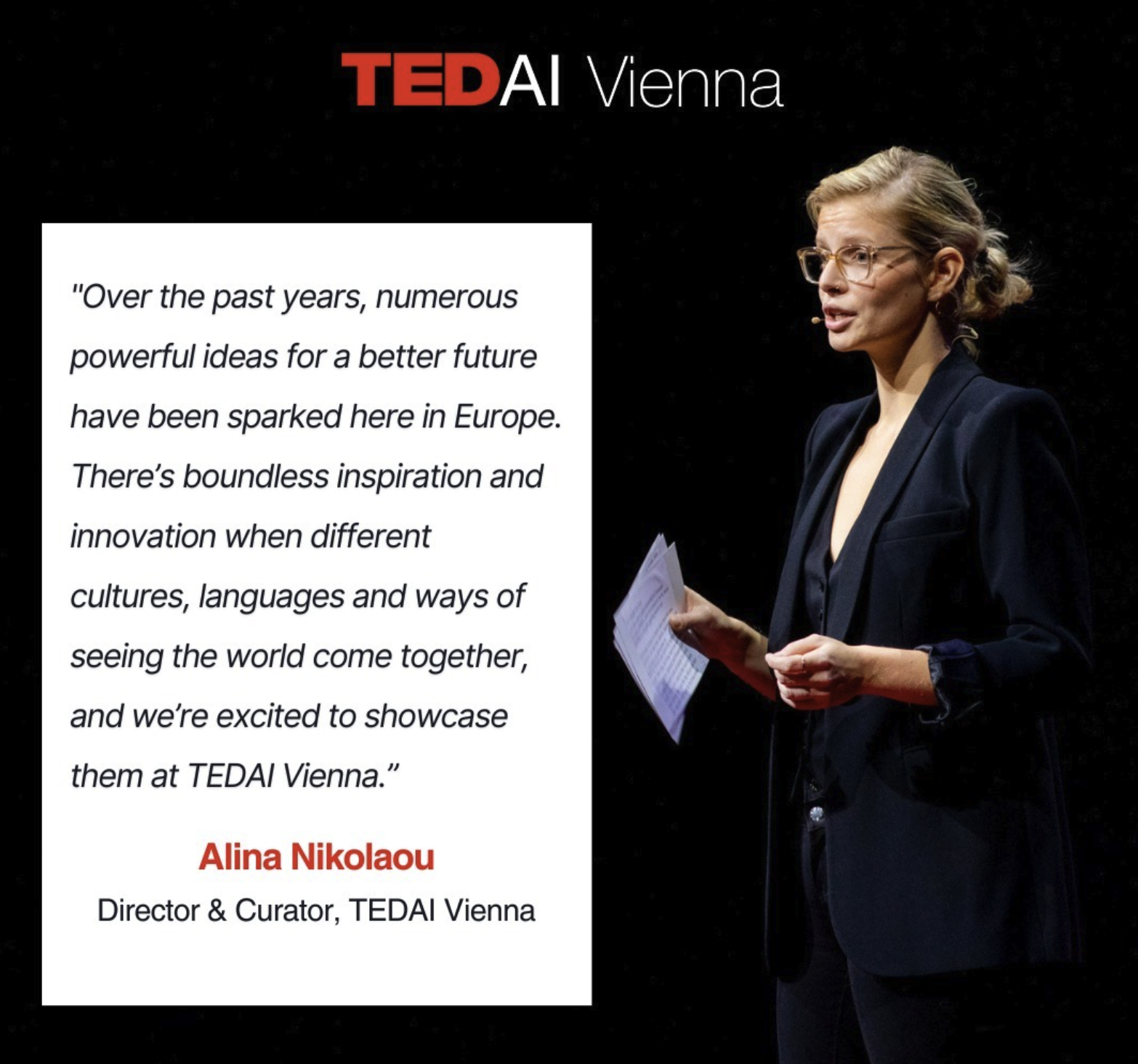
Source: @tedaivienna (Instagram), [26. March 2024.](https://www.instagram.com/p/C4-sSzGsUcw/?utmsource=igwebcopylink&igsh=MzRlODBiNWFlZA==)
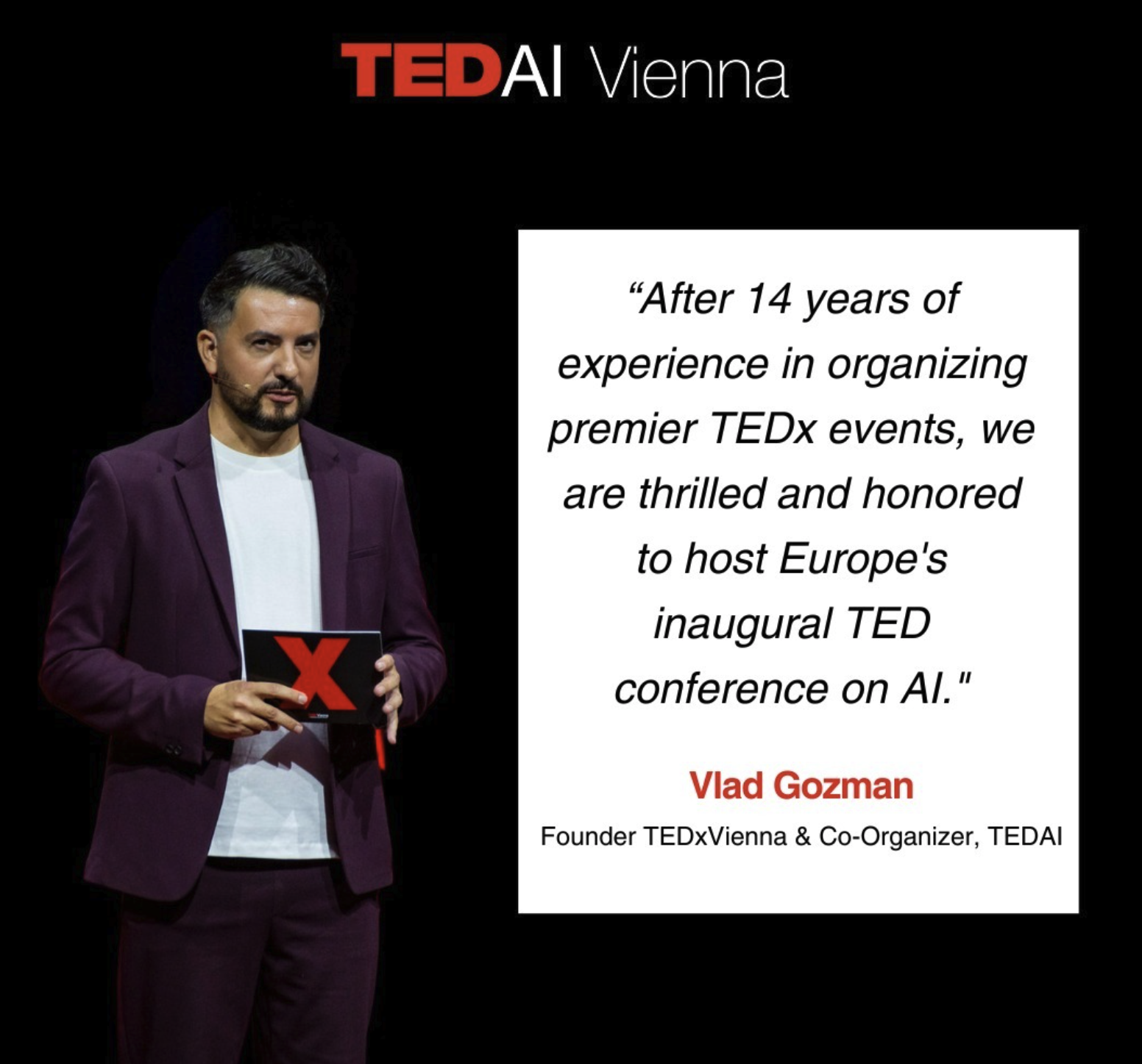
Source: @tedaivienna (Instagram), [28. April 2024](https://www.instagram.com/p/C6T9Fc3MBgp/?utmsource=igwebcopylink&igsh=MzRlODBiNWFlZA==).
We have the opportunity to continue adapting this technology. We have the option to steer it and to focus our research on areas that create meaning for us as a society. Whether we will succeed remains, as always, an open question. But we must be clear that artificial intelligence will trigger the greatest change in society we have experienced so far.