

On 2 March 2021, Jürgen Schmidt, the managing director of STRG, gave a keynote at the JETZT Summit, an annual conference for digital marketing professionals in Austria and the DACH region. Due to the pandemic, the conference was held entirely online, but the virtual participants were no less impressed by Schmidt’s presentation, as their enthusiastic chat comments show.
Schmidt’s natural talent for communicating complex ideas in an entertaining, easily understandable way was on full display. His talk, titled „Data-Diven Publishing Reloaded – The Matrix is Real“, addressed many of the hottest topics in the MarTech industry – natural language processing, machine learning, semantic content analysis, behavioral economics, improving data quality and several others.
A central theme of his talk was how to reconcile the irrationality of human intelligence with the rationality of artificial intelligence. Using entertaining examples showing how this can lead to poor, unintended outcomes (e.g. a Berlin artist was able to fake a traffic jam on Google Maps by walking down a street with 100 Android phones), Schmidt criticized artificial intelligence based on a „supervised“ learning model (i.e., when it is instructed in advance by humans).
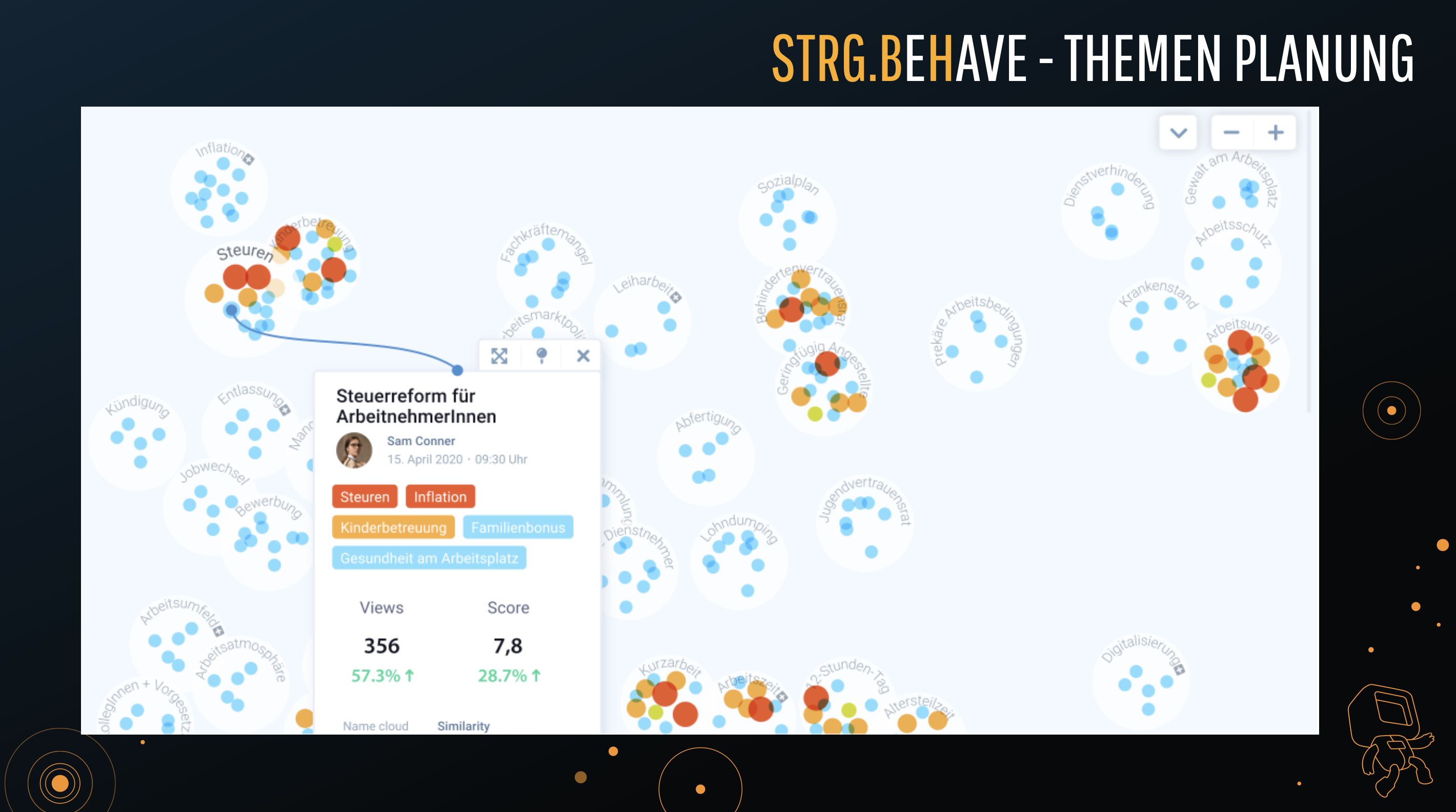
Schmidt explained how the massive increase in computing power and sophisticated programming now offer an alternative, „unsupervised“ model of machine learning, in which computers can analyze and classify data without being given restrictive rules in advance. However, such a model requires enormous volumes of data, which is advantageous for large English-speaking markets such as the USA, while it is possible only to a limited extent in Europe and Asia.
A third model, „reinforcement“ learning, resembles the age-old „carrot and stick“ principle, which represents learning through reward and punishment. Schmidt says that the Agent Smith character from the Matrix films is an example of how such a reinforcement-based virtual machine is able to develop strategies independently, with little or no prior instruction, simply by learning from its own behavior.
„A reinforcement learning model does not require a huge volume of data, since even a small amount of data within a single portal can be extrapolated through data simulation.“
According to Schmidt, a reinforcement learning model does not need the huge dataset required by an unsupervised model, since even a small amount of user-journey data within a single portal can be extrapolated using data simulation algorithms that learn independently through trial and error. This can lead to more intelligent analyses, because it avoids the false feedback loop that can arise from insufficient data – for example, when portals use poor click-rate data to promote „engaging“ content, which is then clicked more often, regardless of its actual interest to the user.
In an interview before his JETZT keynote, Schmidt told Internet World Austria: „When you compare the real results achieved with the data available today, such as click rates, with older methods, you cannot really see much improvement, because nobody makes the effort to consider the underlying quality of the data – its content accuracy.“ He added: „Just because someone clicked on a link somewhere, traditional tracking analysis only tells [content publishers] that they should focus on the same related topics.“
Schmidt criticized the fact that „in marketing technology, we tend to lag behind other industries, especially when compared with modern technologies such as driverless cars, image recognition and deepfake videos.“ It is therefore fascinating to study developments in other fields and learn how to apply them to marketing technology. That is how STRG came up with the idea of using data simulation – by looking at the experimental methods used by Tesla and robotics.“
The use of artificial intelligence for digital media opens up many opportunities to improve portals – especially in e-commerce and digital publishing. STRG develops content management systems that use a proprietary STRG.BeHave AI technology to analyze analytics in entirely new ways, e.g. using principles of behavioral economics.
„The possibilities of data simulation open up entirely new use cases. When traffic volume is low, analyzing tracking data is not very helpful.“
Speaking with IWA, Schmidt said: „We are currently exploring the benefits that arise from using data simulations.“ In data-driven publishing, data quality matters, yet it is rarely discussed. Even AI cannot turn bad data into good solutions. „Garbage in, garbage out“ will always be the rule. „The possibilities of data simulation open up entirely new applications. When traffic volume is low, analyzing tracking data is not very helpful. AI needs a certain volume and breadth of data to be reliable.“
Schmidt also notes that data protection is taken very seriously in Europe, and he believes this is the right approach. The regulatory environment is leading to new innovations that will take digital industries far beyond today’s questionable user consent/opt-out mechanisms. It is becoming increasingly likely that third-party cookies will soon be replaced by technologies such as Federated Learning of Cohorts (FLoCs) in which individual user data is replaced by datasets from groups of users for the purpose of targeted advertising and content. Google is currently exploring a „Privacy Sandbox“ concept to eliminate third-party cookies, and STRG is at the forefront of this movement to simplify marketing technology while protecting individual privacy. Schmidt believes that in the ‘cookieless’ future, far more high-quality data will be available, which will also benefit smaller portals.
To learn more about the technology we use to improve digital publishing, contact either Jürgen Schmidt or Michael Dosser.