

In this article, you will learn how we support our clients in planning and implementing a concept from A to Z. If you have time, read on. Of course, we would also be happy to tell you all of this in person. Contact our Managing Director Jürgen Schmidt today to start a conversation!
The importance of consistent concept planning for IT projects
STRG understands the challenges you face as a forward-looking, ambitious change leader in your company. You are looking for an IT partner who understands the technological challenges of the fast-moving marketplaces, data structures, organisational processes and strategic goals of the 21st century.
We can support you in all phases of your project, from idea to product and beyond, by taking on the following:
The creation of a strategic concept.
Integration and onboarding of all stakeholders.
Definition of goals and KPIs.
Integration of design and development departments.
Creation of modular implementation structures.
Market launch of the product/products.
continuous adaptation to technological progress.
You need an IT partner who can not only implement a plan, but also help create a consistent digital enterprise concept that meets your immediate and future requirements.
We understand such challenges, because we have overcome our own and have successfully helped our clients understand and overcome theirs. How do you approach such ambitious projects? What qualities and experience does your team need? How can you trust that your partners are on your side and have the necessary experience?
STRG does not just build your IT project - we also help you build your company.
At STRG, you will find the expertise, talent and clarity to help your company go deep into the strategy of the digital concept. We work with the most modern agile methods for managing and implementing a project. By bringing strategic planning, design and development together under one roof, your IT project is more likely to succeed and less likely to be derailed by “Mission Creep”. You can also set both ambitious performance targets and realistic budget expectations.
Since 2008, our method has been to guide our clients through an integrated concept and implementation process and give them a clear understanding of how needs can be aligned with their ambitions.
We support you in understanding the why and the how, and in identifying what is to be achieved with it.
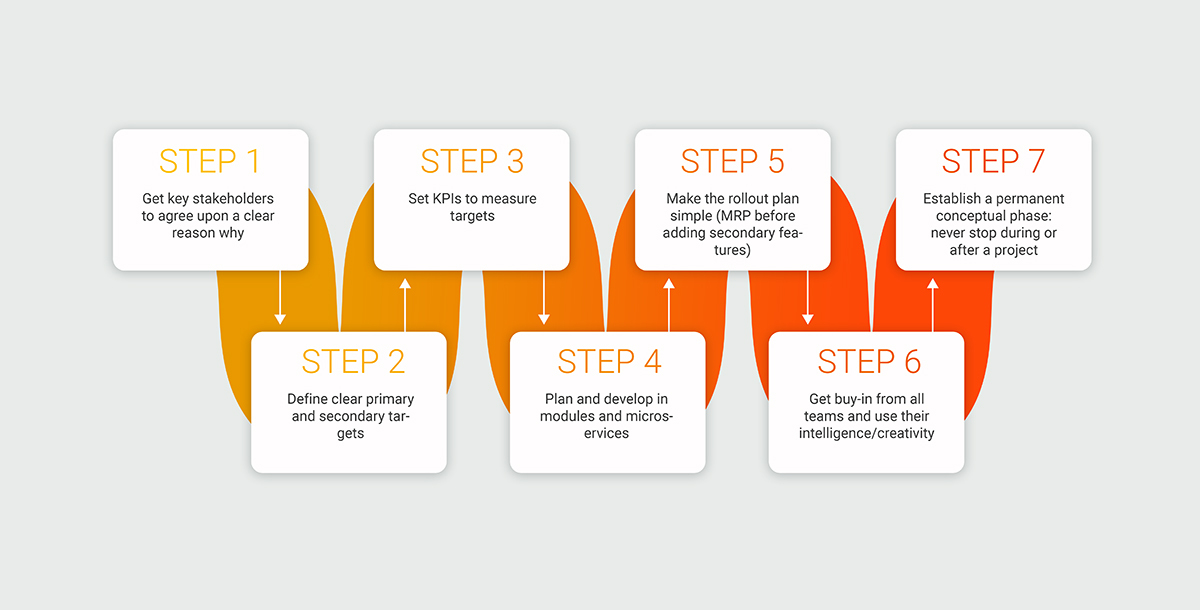
IN 7 STEPS TO A CONCEPT:
Get the key stakeholders to agree on a clear reason.
Define clear primary and secondary goals.
Set KPIs to measure the targets.
Plan and develop in modules and microservices.
Keep the implementation plan simple (MRP first, then add secondary functions).
Get the support of all teams and use their intelligence and creativity.
Establish a permanent conceptual phase: never stop during or after a project.
POSSIBLE CHALLENGES
All too often, well-intentioned IT projects stall or fail to meet expectations. This comes at a huge cost to a company in the form of lost time and resources, and it undermines the morale of stakeholders and employees. There are many reasons why an IT project can fail during development and rollout. One common reason, however, is that a sound, consistent underlying concept was missing from the start – a concept that answers the question: “Why?” If there is no consensus between the company’s key internal stakeholders, the various work teams and the external contractors before a plan for the how is defined, the outcome is likely to be doomed to fail.
Many IT consultants charge their clients high hourly rates and countless meeting hours to create an IT project concept, only to leave it to the client’s internal or outsourced designers and developers to implement. Often, the goals of the concept then meet the sober realities of implementation. If the implementation teams are not pulling in the same direction, without a shared understanding and acceptance of the original concept, things often go wrong. Mission Creep, budget overruns, poorly conceived content architecture, launch delays and internal turf wars are just a few examples of poor outcomes. STRG is not just a consultancy or a developer – it is both in one, and more! We help create a sound strategic concept and develop only what your company really needs. Our team supports you in creating a strategic concept and coordinates the design and development of the entire initiative.
With this holistic approach, STRG is by your side from the start, communicates efficiently with all stakeholders and adheres to a workable and predictable budget framework. Every cent you spend on your IT project is an investment in your digital future, not money thrown out the window.
UNDERSTAND THE “WHY” FIRST
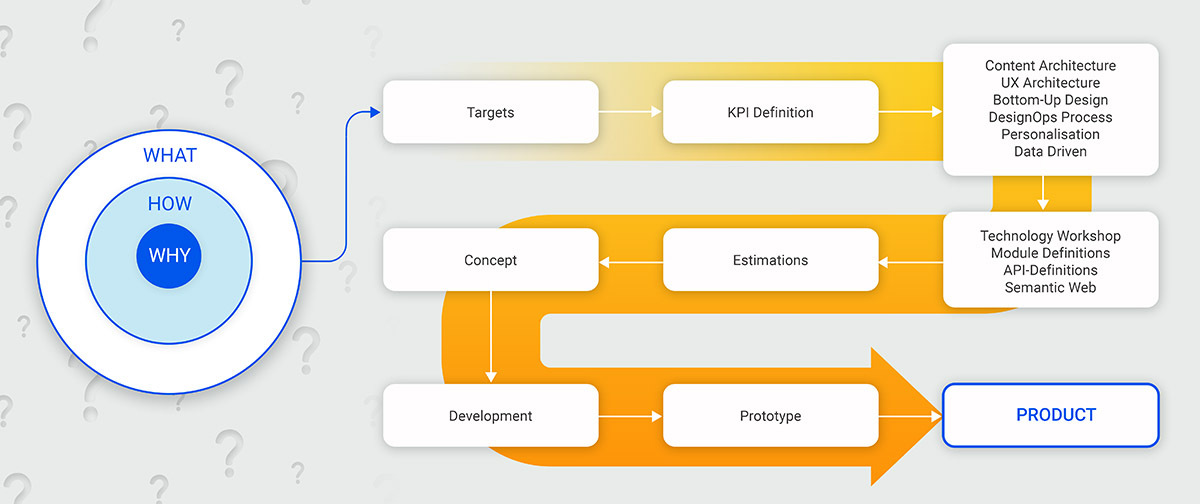
When you come to STRG with an IT project, the first thing STRG asks about is the “why”. It is important that you invest the time and effort to know why you want to do this and what you want to achieve with it. The core concept is defined by the answer to the question “Why?”, and if this concept is not supported by all stakeholders, designers and developers of your IT project, it will not run smoothly. “All roads lead to Rome,” says STRG Managing Director Jürgen Schmidt. “There are many ways to solve a problem, but we have to find the right path for each individual client, and that is only possible if we both understand the reasons behind it.”
To help you create a concept, STRG runs a kickoff workshop with your key stakeholders to find the true answer to the question of why you need the project. “Sometimes clients answer: ‘Because we want to increase our revenue,’ or they simply recite their official vision statement,” says Schmidt. “But I tell them that these are not compelling reasons. Every company wants to maximise its profit, but customers do not buy what you do; they buy why you do it.Revenue is the result, the side effect of value creation for the customer.“ Even if a company’s stakeholders believe they have the same reasons for investing in an IT project, a STRG kickoff workshop often shows that the key stakeholders disagree. „In one customer workshop, I asked the roughly 20 participants the question of ‚Why‘. Their immediate answer was: That is a stupid question, everyone knows what we are and why we exist.“ Schmidt then asked them to give their individual answers while he noted them on a flipchart. „A few hours later, I had written down two dozen completely different opinions about why the company should focus on digital innovation in the future!“ A potential catastrophe averted!
Another customer came to STRG with an existing „strategic concept“ that he had already developed and split into separate implementation projects – Social Media, direct communication, Website, Back-End CMS, system architecture and content architecture. „The CEO told us that he had already communicated the strategy to the respective stakeholders and asked them to work independently on creating the individual sub-concepts and then come back after a year to combine everything into a master plan“, Schmidt recalls. „I had to give him the bad news that this would never work – each team was heading in a different direction, and there was no viable way to bring them all together.“
Only once the customer has agreed on its primary core goals can the project be divided into smaller, goal-oriented teams, each pursuing its own secondary goals without losing sight of the core concept.
DEFINING AND MEASURING PRIMARY AND SECONDARY GOALS
The required number of strategic concept workshops can vary – as can the number of participating stakeholders, depending on the size of the company, budget and existing team structures. Sometimes, particularly stubborn and uncompromising internal stakeholders are excluded at this stage because they feel threatened by change and can disrupt the ideation process. „Fear is the worst adviser“, says Schmidt, but sooner or later their approval will be required as well.
Once the primary goals have been defined, STRG develops the corresponding methods for measuring their success. KPIs and various measurement tools are defined. With these methods, every step of the journey can be evaluated, and undesirable developments can be identified and managed early enough – before they can ruin the entire project. The concept, its primary and secondary goals, and the performance indicators are then documented in a strategic concept paper that serves as the „Bible“ for the entire project and helps the customer successfully onboard its working teams. It also helps STRG determine the resources needed for implementation, enabling fair and predictable cost estimates.
WHERE CONCEPT AND DEVELOPMENT MEET
In some cases, the customer has already completed the Design Ops phase, meaning art direction and the graphical UI plan. This can be a decisive factor: If the design concept was developed separately from the rest of the project – e.g. if a design previously intended for offline content is now also expected to meet digital requirements – this can cause the hard-won, unified project concept to fail. „„In the best case, the customer entrusts both design and development to our experts“, says Schmidt, „but if a customer insists on using their own designers, we insist that they be included in the original project planning, otherwise the project launch will hit one obstacle after another and require more time and budget resources.“
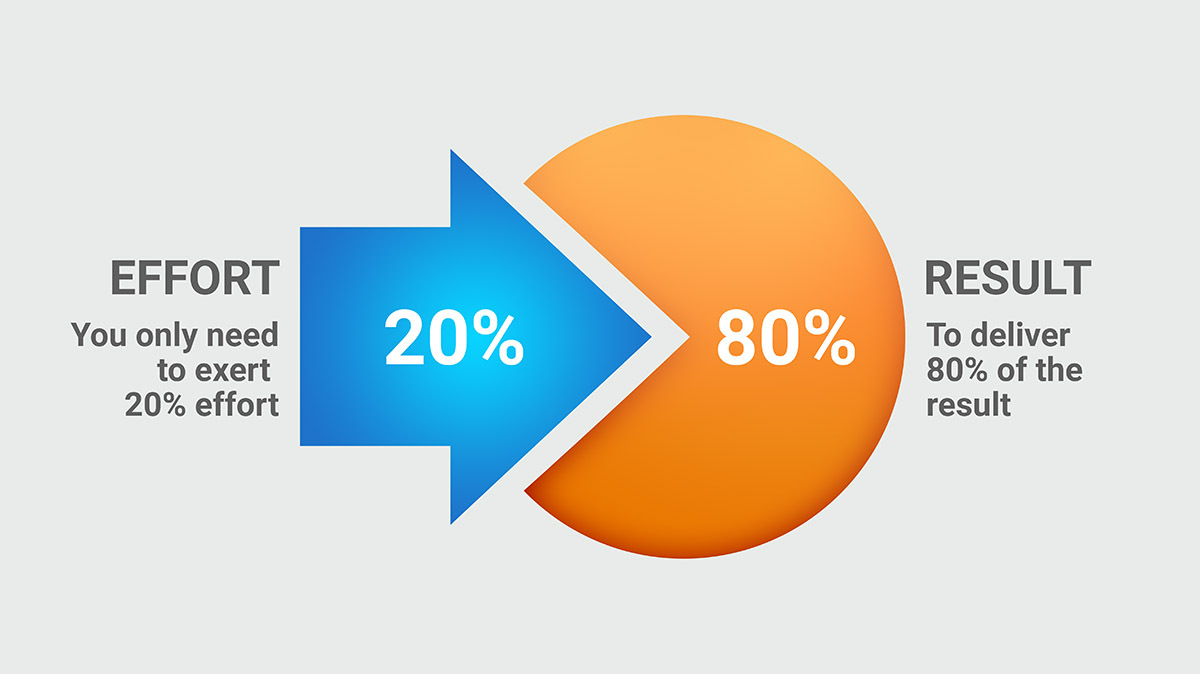
The customer needs to become familiar with the 80/20 Pareto principle: 80 % of the project is completed with 20 % of the personnel and budget resources. The remaining 20 % absorb around 80 % of the effort. If Design Ops and Dev Ops do not work together, i.e. if the frontend UI designers do not understand the possibilities and limitations of the backend developers (and vice versa) – the ratio between effort and result consequently increases.
THINKING IN AGILE MODULES
Once the design and development departments are on the same wavelength, our master plan is carefully divided into modules to define action steps and backlogs that achieve the primary and secondary goals. These modules can be assigned to the customer’s internal working teams, outsourced contractors or STRG employees. STRG experts can cover all aspects of the design and development processes: incl. graphic designers, data scientists, backend and frontend developers, system architects and content specialists.
Sometimes the modular plan can also be created entirely offline, by arranging color-coded notes on a pinboard, with each note describing a different module or a backlog issue. (It may seem ironic for a technology company, but sometimes analog methods work best!) Each note represents a module, a requirement and an implementation phase … „Here is the comment system, there a rating system, here an image gallery, there a small piece of content or a long-read article, here an upper connector and so on – all separate modules“, Schmidt explains. „For the rollout of the first MRP [minimum reliable product], for example, we need to publish an article, attach images/videos … Looking at the backlog, you can define implementation phases and plan in an agile and modular way from the outset.
The STRG internal teams work with modern agile methods (Scrum), which are a perfect fit for a modular development process. „Sometimes, however, a customer expects everything at once. Unfortunately, we sometimes have to reject these wishes as well. A few exceptions are fine, but as a way of working, that will never really work“, says Jürgen Schmidt, STRG founder & CEO.
Agile project management enables a progressive development process. Whenever a stumbling block arises between development and the master plan, the agile process allows feedback to go back to the original stakeholders, department heads, designers, editorial team, marketing department, etc. and then back to the developers in order to work out a practical solution.
STRIVE FOR CLARITY
Many customers get creative once they are deep in the project development phase. „One of our customers decided in the middle of the project to add another function“, Schmidt recalls. „He wanted to publish recipes with a user rating system. It was only an afterthought that sounded simple enough, but the technology required for implementation would have blown the budget. When we raised this with the customer, it turned out that this function was only a spontaneous idea from the content architecture team and was not at all central to the project brief.
In other cases, however, an unplanned feature may be valuable enough to implement after the consolidated plan has been approved. „When we worked with the Austrian automobile club ÖAMTC, its travel agency division discovered that, without access to its member data, it would not be able to market various travel offers to members“, Schmidt recalls, but GDPR (data protection regulations) restricted the sharing of such data. „Although this was not originally one of the project objectives, the additional cost and effort required for implementation were worthwhile and ultimately helped to increase revenue threefold.
Regardless of whether a client asks for too many options from the outset or a flood of features emerges during development, STRG believes it is important that things flow from simple to more complex modules. For example, it makes no sense to develop a reader commenting system before a website has enough visitors. The priority must be on the services that build traffic from the beginning. If a client wants to launch all features at once, they have nothing left to communicate later, and if even one feature does not work smoothly, end users can easily reject the entire project.
In line with the modular concept, modern system architecture benefits from separating specific functions into distinct microservices, each with its own API and database architecture. This allows individual modules to be launched, optimized, replaced, or removed independently without affecting the business logic of the entire system, as is the case when developing a monolithic architecture. If a problem occurs with one microservice, it does not affect the entire website.
AN ENDLESS CONCEPT
Ultimately, there really is no real end. A project concept must always remain flexible and adapt to evolving technological innovations and user needs. Conceptual planning should never be regarded as a one-off event that is done once. During a project and beyond, the conception process should be embedded as a permanent, measurable business methodology.
The answer to the question „Why?“ should be a North Star, but not an eternal truth.
Piqued your interest? Have a few questions? Contact our CEO, Jürgen Schmidt, to start a conversation today!