

Agile working took a great deal of pressure off us during the Covid-19 lockdown. Could it help you succeed as well?
The digital revolution has changed the global economy in countless ways. The COVID-19 pandemic has forced companies to adapt even further. Only the most agile companies are able to benefit from constant technological change, demonstrate value to clients, and keep their own workforce productive and motivated. In 2019, STRG took a major step forward by introducing a „Scrum“ framework for agile software development. Since then, we have not looked back – our productivity has increased, our clients are more satisfied with our transparency, and our delivery performance has barely suffered from the COVID-19 sh*tstorm.
An agile mindset now permeates every aspect of our work. We are on the verge of becoming a holistic, agile service organization! What does that mean for our clients and for our own future? Read on or call Jürgen Schmidt directly: +43 699 1 7777 165
Agility in the new millennium
More than a hundred years ago, Henry Ford set the industrial revolution in motion by introducing the assembly line. His innovative factory could produce a new car faster than the paint could dry. His radical reorganization of work into simple, repetitive tasks was perfectly aligned with the mechanical product being produced. And it also matched the mass market’s growing demand for affordable, high-quality vehicles. As the economy shifted from industrial production to IT services, this 20th-century concept of work was slow to adapt. Service companies that continued to use assembly-line methods found that they could not keep pace with rapid change. Their employees did not take responsibility for overall client satisfaction, and their management hierarchies became complex and unproductive. In recent decades, management methods have continued to develop, especially in software development. Yet even a modern method such as Waterfall still resembles its industrial predecessor: each phase of a project must be completed on the „assembly line“ before the next can begin. First design, then planning, then implementation, then testing, then deployment.
In complex, multi-layered digital IT projects, this can have negative consequences. The longer a development process takes, the higher the risk that the finished product will be redundant or incompatible. The client is often left in the dark between signing the contract and receiving the finished product. And the developer is financially liable if the project does not proceed exactly according to plan. This often leads to increased pressure on development staff, creates the need for a strict hierarchy, and results in client expectations not being met. „With Waterfall, the final outcome and its development phases are defined in advance and a linear path is set out“, says Jasmin Müller, process manager at STRG. „If any obstacles arise along the way, it is very costly to take a step back. If a client changes the original concept or asks for new features during development, the entire project comes to a halt while the original contract terms are renegotiated.“
Agile working with Scrum
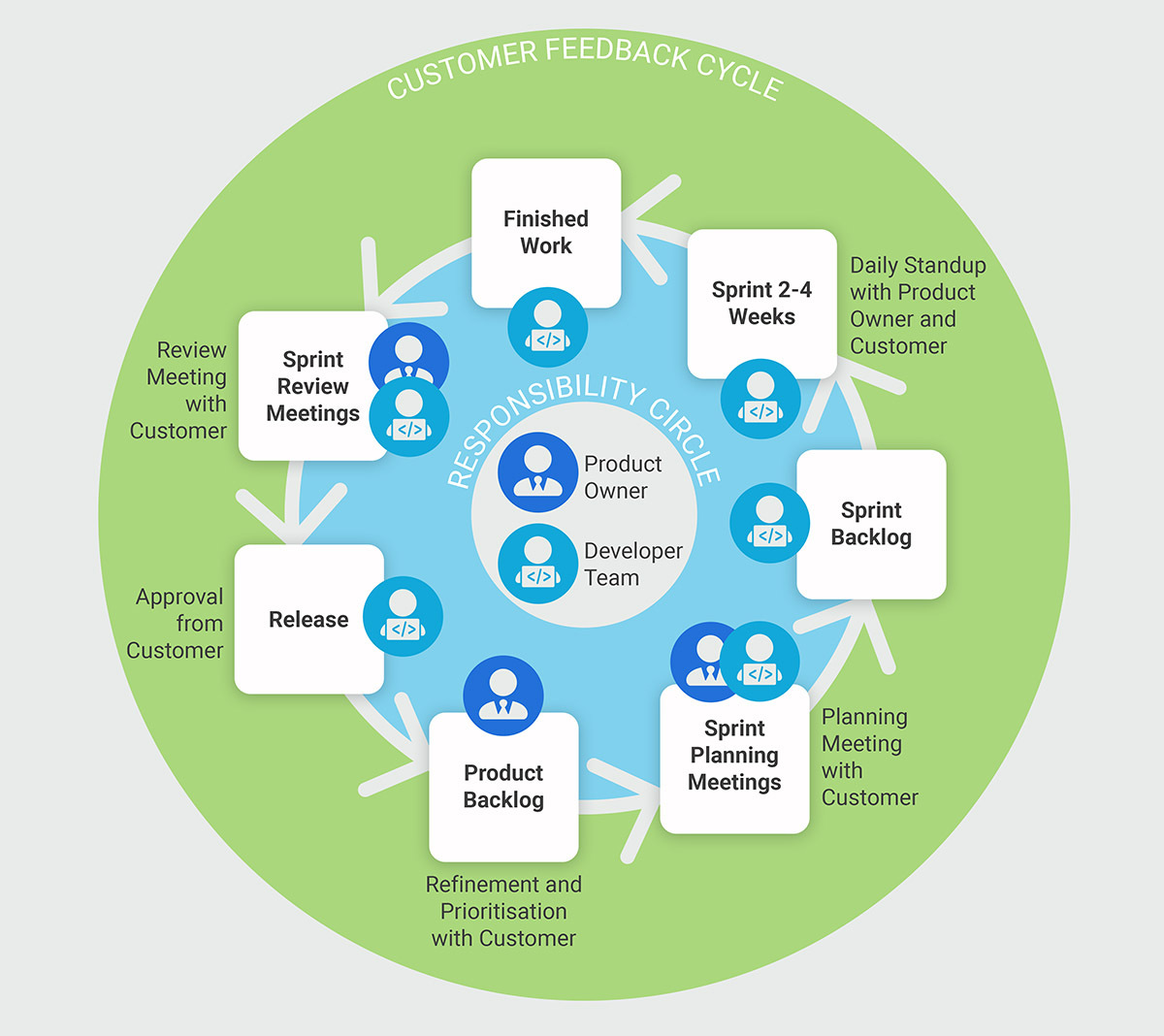
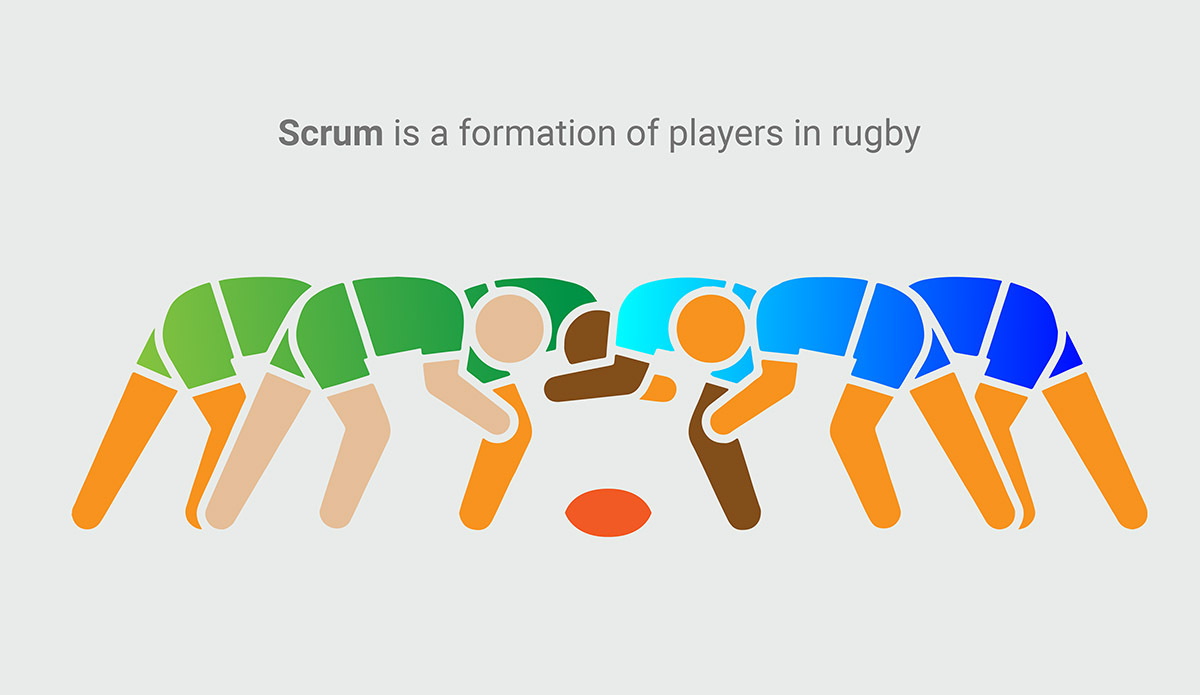
„Scrum“ is a modern management framework that enables flexible business practices, especially for software development. Like its namesake from rugby (the „scrummage“), where team members bind their arms and heads together to gain possession of the ball, a Scrum development team works towards a shared objective, while each member can make independent efforts to move the whole team forward. By „sitting together“ during short „daily scrums“, the entire team is informed about what each individual member has completed, what problems may have arisen, why progress has stalled, and what the target is for the next 24 hours. The „Product Owner“ – a team member who acts as the client’s proxy – plays an important role in the team, but there is no management hierarchy among team members, who differ greatly in terms of their skills and experience. Instead, the team regulates and organizes itself to handle the tasks required to complete a project. The team itself sets incremental two-week or monthly delivery goals, called „sprints“.
Scrum is a simpler and more flexible working framework that is better suited to complex projects and increases internal and external transparency. In our complex business, an end product often cannot be defined precisely from the outset. A detailed concept with primary and secondary objectives, KPIs, and a timeframe is planned, but actual development is a continuous process of learning and adaptation, both for us and for our clients. Quoting a fixed price at the start is a recipe for disaster – there is no way to know in advance how much effort will be required. Scrum allows us to work towards a project objective in shorter „sprints“, learning and reviewing as we go, until an „increment“ can be completed, reviewed, and approved by the client. Through the Product Owner Proxy, the client has regular full transparency throughout the entire development process and understands the ROI throughout the process. „When they receive our monthly invoice“, says Jürgen Schmidt, Managing Director of STRG, „our clients know exactly why the hours were billed and what was delivered, because they have reviewed every sprint or participated directly in the daily scrums.
„With Waterfall, the client had this kind of overview at best on a quarterly basis“, Schmidt adds. „After such a long period, it is quite difficult for the client to understand the hours we have billed or to see our productivity.“ In addition, cash flow is better aligned with project expenditure, which takes pressure off the entire organization. „Without this top-down stress, each individual’s productivity increases and we can focus on delivering value to the client.“
The leap to Scrum
„To change an organization, it is crucial to get everyone on board“, says Müller. „It is often said that everyone wants to change, but no one wants to be changed“. At STRG, the impetus for change came from within. A few years ago, we held a company retreat, and our developers made it clear that the stress caused by inflexible deadlines and unrealistic customer requirements called for better planning and accountability for their productivity. „Every implementation felt like a chase“, Schmidt recalls, „we worked from one day to the next without a solid plan, and often our defined goals were missed or left unfinished.“
„Something had to change, but at first it was not immediately clear that Scrum would be the answer. We began implementing a few agile processes in a pilot project – a small team working on our internal research and development project STRG.BeHave, so there was no external pressure from the client. We presented the results of the pilot project at our all-hands meeting, and the feedback was excellent. Everyone was immediately enthusiastic about the idea!“
Thanks to a highly profitable result in 2018, Schmidt and STRG’s leadership team were on solid ground, with sufficient reserves to finance the structural change throughout.
„At the beginning, our productivity declined slightly, and that made me very nervous. There was no going back to the previous methods, and we were drawing down our reserves.“ But that was short-lived. The productivity curve rose exponentially shortly after the „downturn“. It became clear that our contracts had to be changed so that our increased productivity and flexibility under the Scrum framework would also be reflected in our bottom line. Although agile software development is common practice abroad, it is less widespread in Austria. „It took a lot of effort to convince our local clients that they would benefit from a flexible billing structure instead of signing a guaranteed fixed-price contract“, says Schmidt, „but most of them recognized the advantages of transparency, adaptability, and involvement in the development process.“
Because the client is represented in our Scrum development team by a Product Owner, a mutual „us-versus-them“ mentality is avoided. „Many clients do not have the knowledge required to lead a software development team“, says Müller. „There is much more to it than simply knowing what you want in the end. Like an interpreter, the proxy conveys information between the client and the team. The client does not have to wrestle with the smallest technical details and still remains fully in the loop.“
Scrum as "vaccination"
When the COVID-19 pandemic forced global business to a standstill, STRG employees were already well prepared to adapt to working from home, because they had already initiated the structural changes the year before. „I was so relieved that we had already got Scrum up and running before the lockdown began in March 2020“, says Schmidt. „The transition would never have worked in the middle of the crisis, when every company was focused solely on staying afloat rather than growing.“
Although our employees suddenly had to get used to the virtual office, the tools to make it possible were already in place. Daily Scrums could be held by video conference, and our JIRA workflows were already aligned with the way we practice Agile/Scrum. „Our best quarterly result to date was the first quarter after the closure“, Schmidt boasts. Our productivity and the quality of our work were better than ever before.“ By the end of the year, however, morale was affected by a new wave of even stricter restrictions as winter set in. For the developers, who were already used to Scrum, it was far less difficult than it would otherwise have been, but for business development, marketing, and client relations management it became much harder.
Schmidt recognized that „it will not be possible to move permanently to a remote office, and that we all need personal contact.“ STRG cleared out its former co-working office and rented a new location on the top floor in the trendy seventh district in Wien. With the easing of lockdown regulations and the increasing number of vaccinated people, employees could now establish a perfect balance between remote work and „IRL“.
When we moved into the new office space, the Scrum mindset was firmly embedded in our development teams and across the entire company. We were essentially a fully agile service organization, from top to bottom. „Even our board has a daily Scrum, and that has significantly improved our communication“, says Schmidt.
Transparency + Flexibility + Fairness = Happiness
Ultimately, every process change must be measured by performance. For the business owner, that means cash flow and the bottom line. But the Scrum team has other currencies for measuring performance: „Did we meet our deadlines?“ and „Are our clients satisfied?“ „Transparency is crucial to keeping our clients satisfied“, Schmidt and Müller agree. „Our most satisfied clients are those who are most deeply involved in the project, who understand the costs and benefits at every step of the journey, and who have the flexibility to change their planned route when necessary.“ Partnering with an agile service organization is the only way. By adopting the agile development framework, STRG practices what it preaches. If you are considering making the leap to agility and would like to learn more about our experiences – or if you are looking for a software development partner who offers you full transparency and collaboration – let us talk!